
















The Montreal Art Girl Never Disappeared—She Was Recording Everything
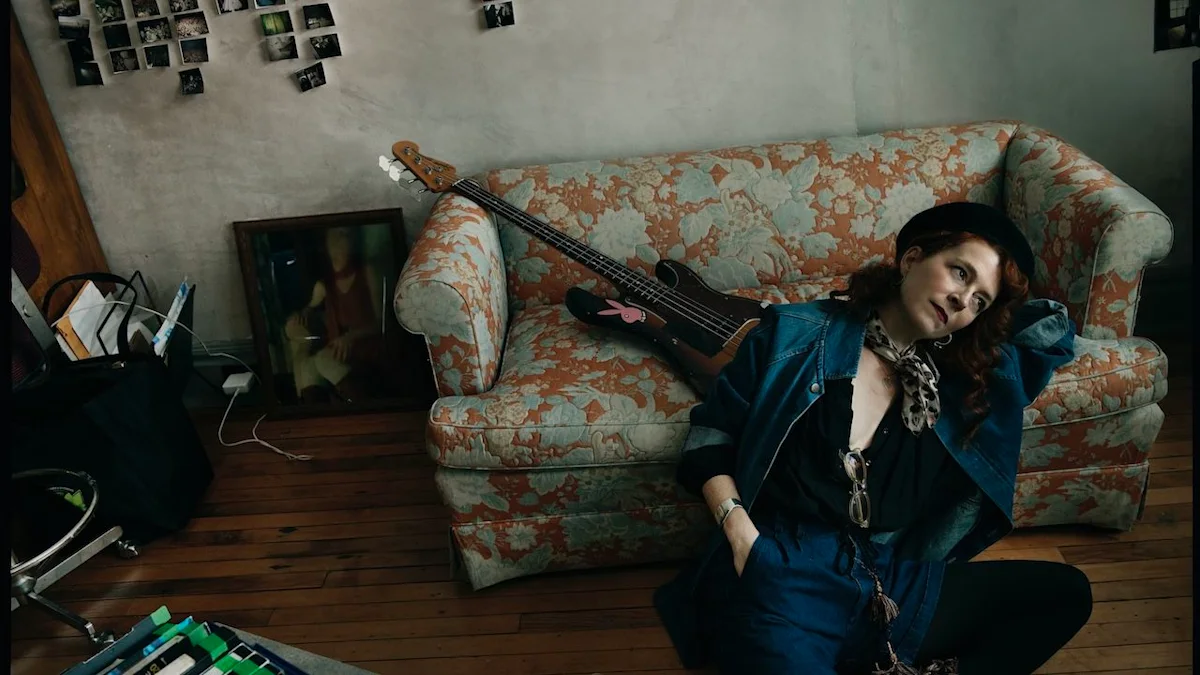
Melissa Auf der Maur is returning with her first newly released music in 16 years, but she is not simply dusting off the bass for a conventional comeback album. She is opening the door to the private room that existed behind the arena stages, major-label machinery and alt-rock mythology of the 1990s.
Bass Womb Room: My ’90s 4-Track Demos x Field Recordings arrives digitally and on cassette September 4 through Envision Records. The 15-track project pairs seven previously unheard four-track demos with eight new interludes composed for Auf der Maur’s forthcoming museum exhibition at the Art Gallery of Ontario.
The result sits somewhere between an album, an exhibition soundtrack and an audio self-portrait. It reconnects the musician who played bass in Hole and toured with The Smashing Pumpkins with the Montreal photography student who kept documenting, recording and experimenting even as the music industry demanded increasingly polished radio hits.
Listen + Revisit
Enter Melissa Auf Der Maur’s Analogue Archive
Explore the AGO exhibition, revisit her ’90s memoir and find the four-track tools behind the private recordings.
Some links may be affiliate links. INYIM may earn from qualifying purchases.
Auf der Maur recorded the seven demos alone in her Los Angeles living room during the ’90s using a trusted Tascam four-track cassette recorder. Acoustic guitar often formed the base before she layered vocals, bass, a cheap keyboard and lo-fi studio tricks including reversed tape and pitch shifting. Some lyrics emerged as streams of consciousness; others came directly from the diary she wrote in every day.
The recordings preserve details that a glossy studio session might have erased: blistered fingers, desire, thoughts about the moon landing and ordinary sounds captured on the pocket cassette dictaphone she carried beside her camera. A dripping faucet and the click of a shutter became part of the same archive as the songs. Other than modern mastering, the demos have reportedly been left as she recorded and mixed them at home.
Auf der Maur said the material was created while she and her peers were facing pressure from a major-label system hungry for immaculate singles that could dominate radio. The home recordings gave her somewhere quieter to experiment and protected the “Montreal art girl” inside the musician who had joined one of America’s biggest rock bands.
The eight new pieces pull that private past into the present. Co-produced with Alex Crow, the interludes incorporate archival sound from a video camera Auf der Maur would place on her bass amplifier during Hole and Smashing Pumpkins performances. While the camera faced the crowd, it captured the noise, movement and collective charge coming back toward the stage.
Those audience recordings are sampled and threaded together by a recurring heartbeat, connecting the pulse of the bass with the project’s womb imagery. The title reflects Auf der Maur’s view of the bass as the maternal center of the music: the frequency underneath everything else, holding the body of the song together.
The music will live inside the exhibition’s immersive Bass Womb Room installation, a mirrored, 360-degree environment of sound and video designed to bridge two versions of the artist: the private inner self and the performer experiencing the near-spiritual communion of a live crowd.
Melissa Auf der Maur: My ’90s Rock Photographs opens to AGO members September 2, with public access beginning September 8. Drawn from an archive of more than 10,000 images, the exhibition presents over 200 photographs, videos and pieces of ephemera documenting motel rooms, tour buses, empty roads, audiences, bandmates and the last analogue years before smartphones turned every backstage moment into immediate content.
The project also arrives after Auf der Maur’s 2026 memoir, Even the Good Girls Will Cry: A ’90s Rock Memoir, and alongside a 240-page photography book. Together, the memoir, exhibition, book and music do not merely revisit her past. They reveal that she had been building a parallel body of work the entire time — camera in one hand, bass in the other, refusing to let the machinery around her become the only version of the story.
Bass Womb Room follows Auf der Maur’s 2010 solo album Out of Our Minds. Its track list moves between private demo titles such as “Active Heart,” “Desire Is Critical,” “Flesh Flush” and “Is She His,” and newer interludes including “Courtney Chimes In,” “Billy Seoul Crowd,” “Sparkle Bass” and the closing “Skip a Beat.”
Watch Hole At The 1998 MTV Video Music Awards
The archival clip shows Melissa Auf der Maur alongside Courtney Love and Hole during the 1998 MTV Video Music Awards.
Sources: Art Gallery of Ontario; Bass Magazine; Pitchfork.