














Humans take flight to restore a lost migration.
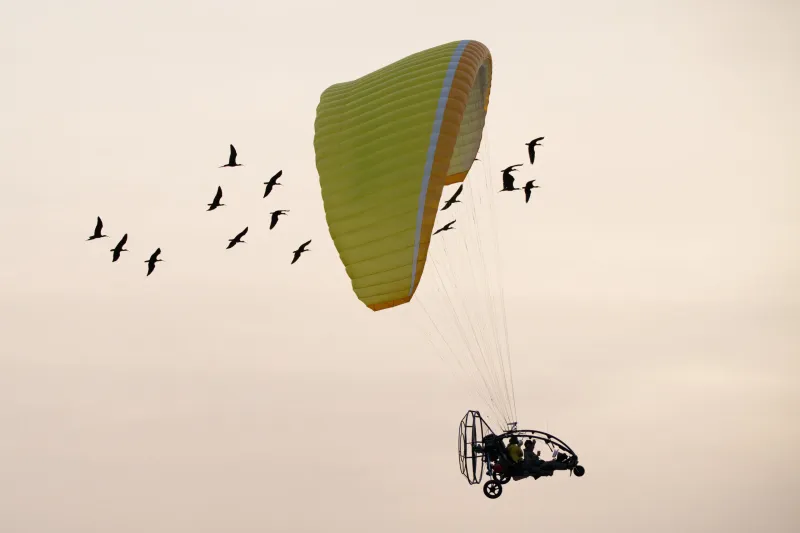
Get this: a team of conservationists is demonstrating to endangered birds how to migrate south by flying thousands of miles right beside them.
The birds are northern bald ibises, also known as Waldrapp, and the humans leading the way belong to the Austrian conservation and research organization Waldrappteam.
These are not robotic birds following a remote-controlled toy. Young ibises are taking to the air beside a lightweight flying machine while their human foster parents wave, call and encourage them from the passenger seat.
The aircraft may resemble a paraglider from the ground, but it is technically a motorized ultralight or microlight trike suspended beneath a flexible wing.
Think Fly Away Home, only this is a real conservation mission involving an endangered species that disappeared from Central Europe centuries ago.
Follow the human-led migration project restoring the northern bald ibis to its former European range.
As an Amazon Associate, INYIM Media earns from qualifying purchases.
The birds can fly, but they do not know where to go.
Northern bald ibises once migrated through large parts of Europe, North Africa and the Middle East.
Overhunting, habitat loss and other human pressures eventually erased the species from Central Europe. When conservationists began raising new generations for release, they encountered a complicated problem.
The young birds were physically capable of migrating, but there were no experienced wild elders available to show them the traditional route.
Migration is partly instinctive, but the exact pathway can also function as learned knowledge passed from one generation to another.
Without an established flock to follow, early attempts sometimes ended with the birds scattering, becoming lost or failing to reach a safe wintering area.
Waldrappteam therefore became the missing older generation.
Human foster mothers build the birds’ trust.
The process begins shortly after the chicks hatch.
Human foster mothers raise, feed and care for the young ibises so the birds form a strong bond with them. That relationship is essential once flight training begins.
During the 2023 migration, researchers Helena Wehner and Barbara Steininger served as foster mothers, while biologist and Waldrappteam leader Johannes Fritz helped direct the larger operation and pilot the aircraft.
The young birds are gradually introduced to the machine, including the sound of its motor, before they are expected to follow it through the sky.
Once airborne, the foster mothers call out, “Come on, Waldi, come on,” a familiar phrase the birds have learned to associate with the humans who raised them.
They are not simply chasing an aircraft. They are locating the people they trust.
The result is a flock of glossy black birds flying wingtip to wingtip beside a tiny machine carrying their adopted human family.
The historic journey to Spain.
In 2023, Waldrappteam established a new route from southern Germany to Andalusia in Spain.
The team and birds traveled approximately 2,300 kilometers across three countries over 43 days and 19 separate flight stages.
Thirty-five juvenile ibises began the preparation process, and 32 reached the wintering area near Vejer de la Frontera.
The arrival marked the first time in approximately 400 years that a migrating northern bald ibis flock had been guided into Spain from Central Europe.
The Spanish route was not chosen simply because everybody fancied a warmer holiday.
Climate change has made the birds’ traditional autumn crossing of the Alps increasingly difficult. They now tend to migrate later, when colder temperatures and worsening conditions can turn the mountains into a dangerous barrier.
The path toward Andalusia allows the flock to avoid that high Alpine crossing while still reaching a suitable southern wintering ground.
They are not only restoring an old migration tradition. They are adapting it for a changing planet.
An award-winning image carries the project worldwide.
A photograph from the team’s later 2024 migration has now brought a new wave of attention to the project.
Biogeoscience student and Waldrappteam photographer Gunnar Hartmann captured 19 ibises flying across a golden Spanish landscape ahead of the yellow-winged ultralight aircraft.
The photograph was named the overall winner of Nature’s 2026 Scientist at Work photography competition.
What appears at first to be a dreamy piece of aerial wildlife photography represents weeks of exhaustion, weather delays, careful training and repeated attempts to motivate tired birds back into the air.
The animals appear to be leading the aircraft in the final photograph, even though they are actually following the humans behind them.
That visual reversal makes the photograph even better: the birds look as though they already know the way.
The next generation can continue without the aircraft.
The ultimate purpose is not to have humans escort every flock forever.
Once the young birds learn the migration corridor, they can return north independently and eventually pass that route to their own offspring.
Birds from the reintroduction program have already completed return migrations without human guidance, demonstrating that the knowledge can take hold inside the population.
Waldrappteam’s wider LIFE project aims to establish a self-sustaining European population capable of surviving largely without direct intervention.
The method could also offer a blueprint for other threatened migratory species whose traditional routes have disappeared or become unsafe.
Geese, cranes, storks and other ibis species may eventually benefit from what this famously unusual-looking bird is teaching scientists.
Humans erased the original migration. Now humans are getting into the sky and helping put it back.
Bravo-bravissima to Helena Wehner, Barbara Steininger, Johannes Fritz and the entire Waldrappteam crew.
Dig out the astounding flight footage and meet the brainy bird-saving humans soaring beside their flock right below!
Watch the northern bald ibis migration in flight.
National Geographic follows Johannes Fritz and the human-led migration method that taught young northern bald ibises to follow an ultralight aircraft toward their wintering grounds. The archival film predates the newer route to Spain but shows how the remarkable conservation technique works.
Sources: The National Geographic film provided the featured archival footage; Waldrappteam’s official 2023 migration diary provided the route, distance, training and arrival details; Nature’s Scientist at Work competition provided the award-winning photograph information; and the official LIFE Northern Bald Ibis project provided the current reintroduction goals and population background.