













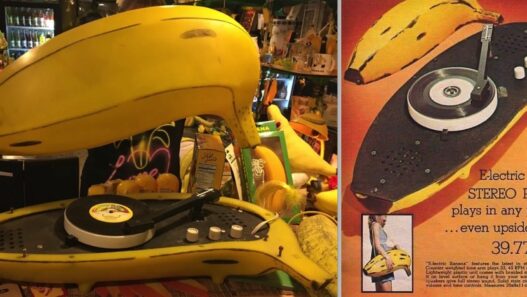
Flashback Friday peels back the E-lectric Banana Stereo Phono.
Today’s Flashback Friday features thee 1970s banana stereo player.
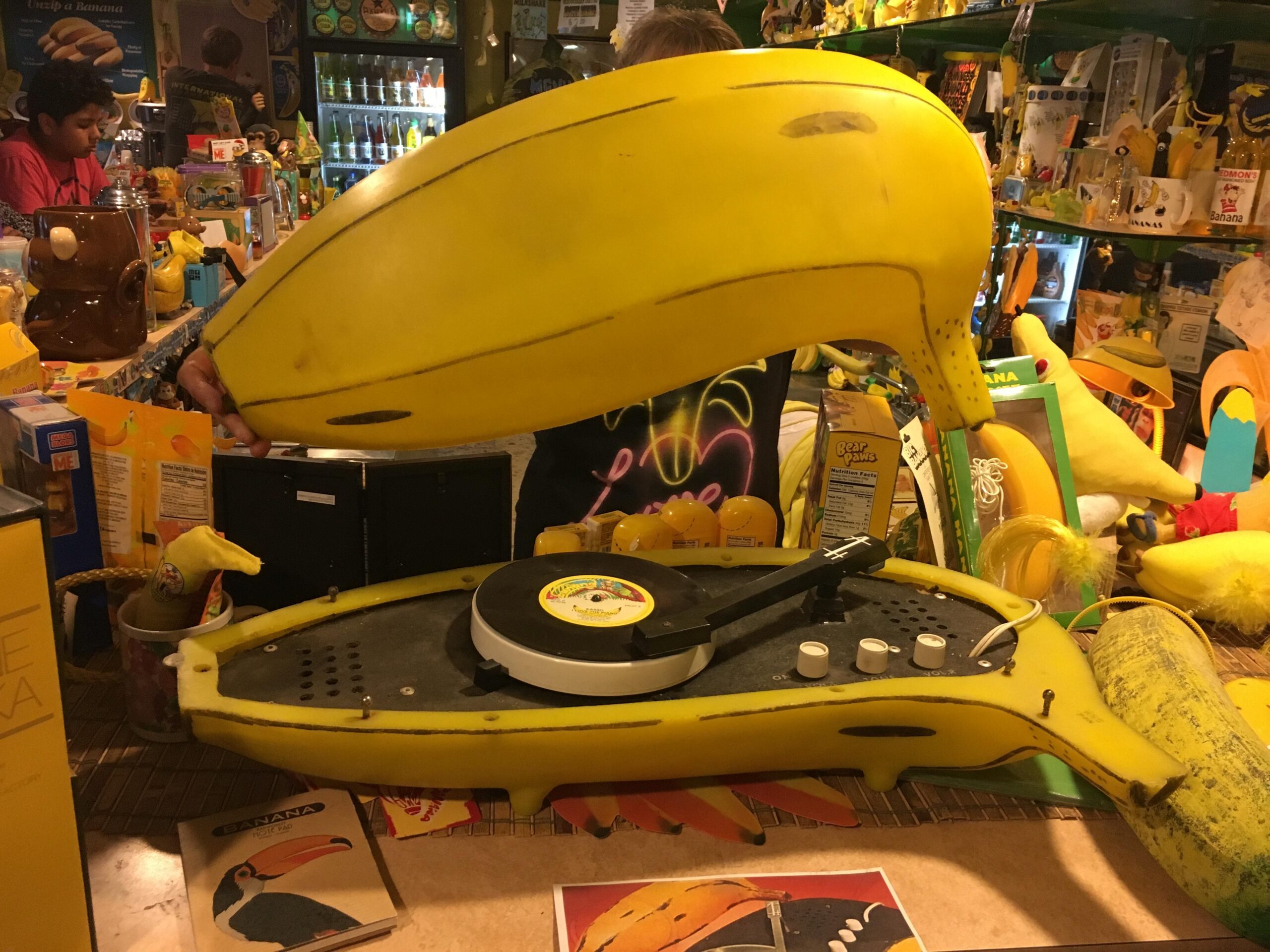
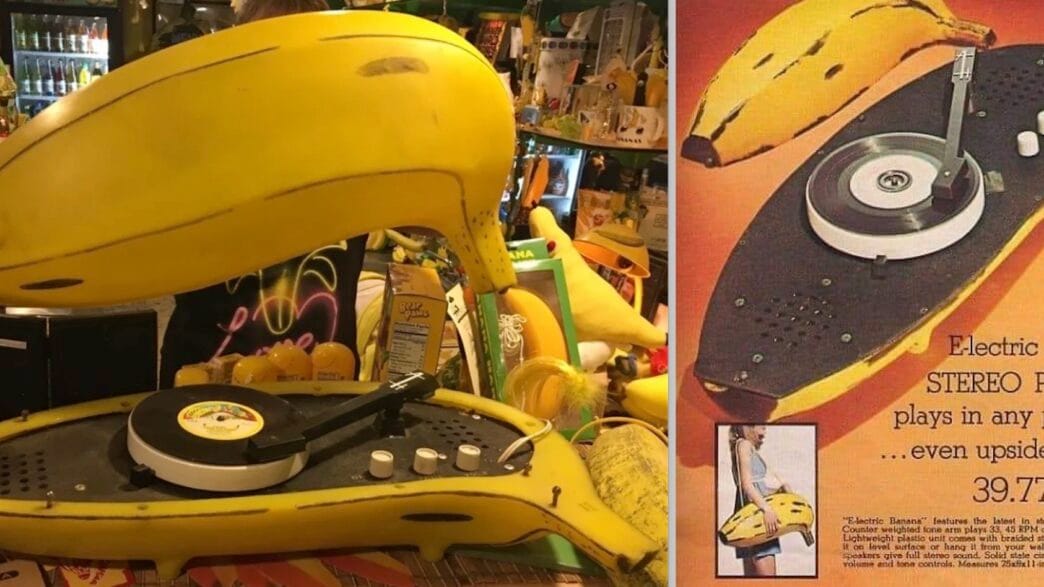
This unusually shaped E-lectric Banana Stereo Phono appeared in a 1973 Spiegel mail-order catalog as a portable, all-in-one record player housed inside a giant banana-shaped case.
The curved yellow shell contained a turntable beneath its center panel, built-in speakers at both ends and a braided carrying strap for anyone determined to bring their musical fruit along for the ride.
The original catalog advertisement priced the machine at $39.77 and boldly claimed that its counterweighted design could play records in any position—“even upside down.”
A record player shaped like produce was already enough. The ability to hang it on a wall apparently needed to enter the chat, too.
Spin vintage-inspired turntables, revisit the Velvet Underground’s famous banana and dig into the design language of the 1970s.
As an Amazon Associate, I earn from qualifying purchases.
This banana came loaded with four record speeds.
Surviving examples of the E-lectric Banana include two four-inch speakers—one positioned at each end of the fruit—with separate volume controls and an additional tone-control knob.
A speed selector allowed owners to play records at 16, 33, 45 or 78 RPM, making the novelty player compatible with several formats that could still be found in early-1970s households.
The center section opened to reveal the small turntable, tonearm and controls, while the outer shell closed into a portable case.
Despite the word “stereo” appearing in its name, surviving examples are generally described as novelty players rather than serious high-fidelity sound systems.
But nobody bought a giant plastic banana because they were chasing audiophile purity.
The mail-order catalog understood how to stop a page turn.
Mail-order catalogs of the era regularly mixed practical household equipment with colorful gadgets designed to attract younger shoppers and families.
The E-lectric Banana took that novelty philosophy to its logical conclusion. Rather than hiding a turntable inside a traditional suitcase or wooden cabinet, it made the entire machine look like one enormous piece of Pop Art.
Original units have since become scarce collectors’ pieces, with surviving examples periodically appearing through vintage dealers and online marketplaces.
The manufacturer behind the machine remains difficult to document, adding another layer of mystery to a product that already looks like it fell out of a surreal 1970s television commercial.
Was Andy Warhol actually connected to the banana player?
The record player is frequently described as being inspired by Andy Warhol’s banana artwork for the Velvet Underground and Nico’s 1967 debut album.
The visual connection is easy to understand. Warhol’s bright-yellow banana became one of the most recognizable album-cover images of the era, complete with a peelable sticker that revealed a pink banana beneath it.
However, no official connection between Warhol, the Velvet Underground and the manufacturer of the E-lectric Banana has been established. A previous owner who investigated the machine reportedly contacted the Andy Warhol Foundation and found no record of an affiliation.
It is therefore safer to describe the player as Warhol-inspired or Pop Art-adjacent rather than an officially licensed Andy Warhol product.
Either way, the banana had already entered the music business. The stereo simply gave it speakers.
Watch how Andy Warhol created the Velvet Underground’s iconic banana.
The video explores Warhol’s collaboration with the Velvet Underground and the peelable banana artwork created for the group’s landmark debut album—not the later E-lectric Banana record player itself.
See the 1973 E-lectric Banana Stereo Phono in INYIM’s archive.
Our secondary social post spotlights the banana-shaped mail-order player, its portable case and one of the strangest audio designs to emerge from the 1970s.
Sources: an archived Reverb listing provided surviving-unit controls, speaker and speed details; Dangerous Minds provided catalog, rarity and Warhol-affiliation context; The Museum of Modern Art confirmed Andy Warhol’s album-cover credit; the featured YouTube video provided the Warhol album-art explainer; and INYIM Media’s Instagram post provided the secondary social embed.