
















The Blonde Architect of Duran Duran Still Has No Plan B
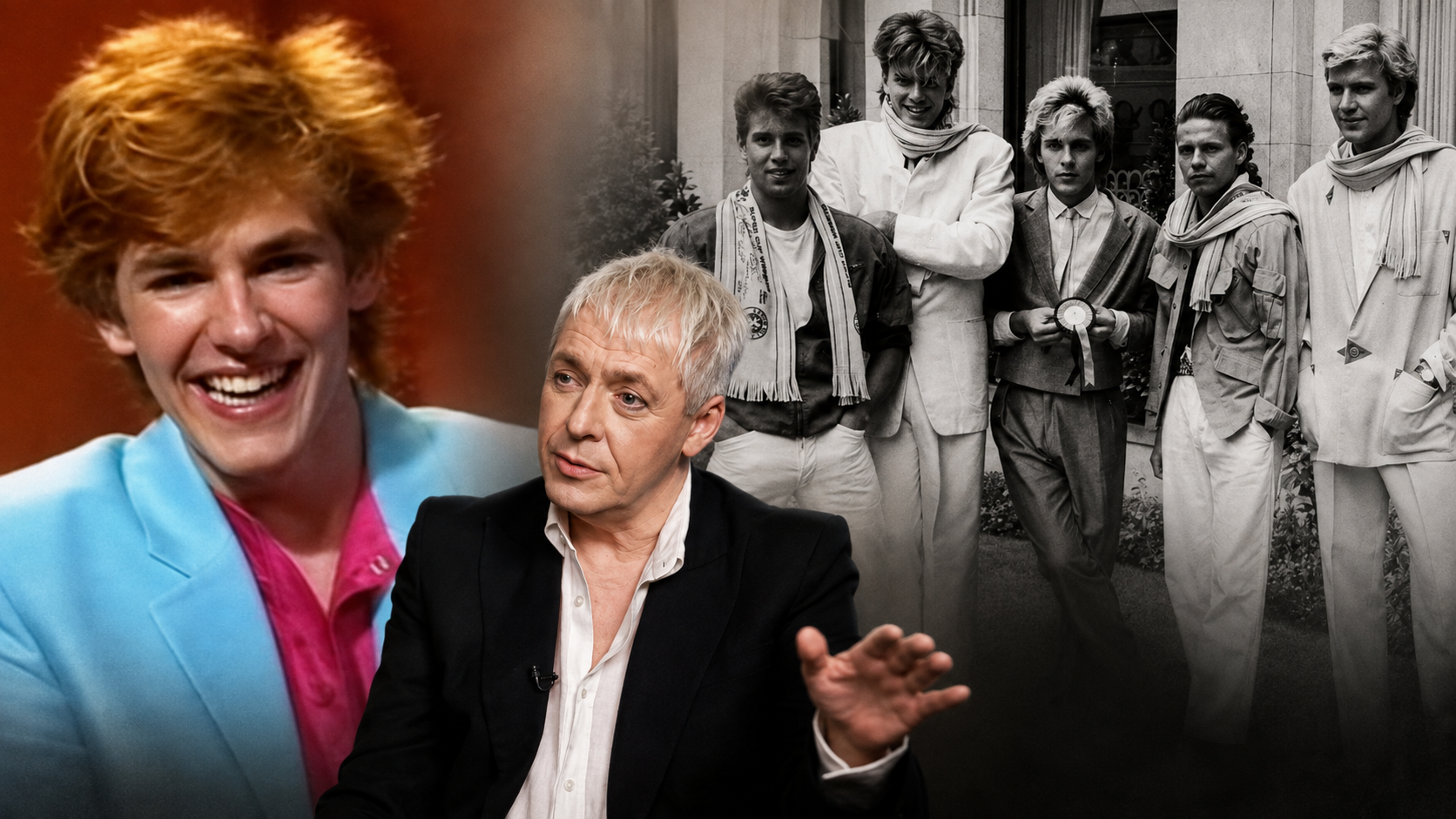
Nick Rhodes has lived the sort of dramatically glamorous pop life that should require its own museum wing—and, judging by the size of his archive, it may eventually get one.
In an expansive one-on-one conversation, Duran Duran’s effortlessly cool keyboardist looks back on the band’s beginnings in Birmingham, the advice Mick Jagger gave him when the group could have fallen apart, his friendships with David Bowie and Andy Warhol, the industry panic surrounding the first paid music download and why a pair of ordinary blue jeans still represents an unforgivable surrender.
Rhodes is now 64, but nothing about his point of view sounds retired, settled or preserved behind glass. The eyeliner remains. The curiosity remains. Most importantly, the band chemistry he helped create as a teenager remains intact whenever Duran Duran enters a studio or steps onto a stage.
Discover More
Keep the Wild Boys in Rotation
Explore Duran Duran’s official world, then revisit the records, visuals and fashion that made Nick Rhodes one of pop’s great architects.
Some links may be affiliate links. INYIM may earn from qualifying purchases.
Duran Duran’s Original Chemistry Is Still Intact
Rhodes says the band no longer disappears for endless months of touring. Instead, Duran Duran works in shorter stretches—roughly a month on the road, followed by time at home before the next run. Their 2026 itinerary continues in October with dates across Europe and the UK, including a homecoming show at Birmingham’s Utilita Arena.
The pace may be different, but Rhodes believes the group’s underlying DNA has barely changed. Their lives now include children, grandchildren and priorities that would have been unimaginable when the band formed, yet the focus snaps back into place when they are together.
“When we’re in the studio and we all plug in, something magical happens,” he explains. It may not arrive immediately, but eventually the chemistry works. Onstage, that shared language becomes even more instinctive.
That longevity also means respecting why people bought a ticket. Rhodes has little interest in artists who refuse to play the songs audiences came to hear in the name of being uncompromising. Duran Duran prefers balance: new material, a few surprises and plenty of thee hits.
David Bowie Turned a Magician and Astronaut Into a Musician
Before Nick Rhodes wanted to become a musician, he wanted to become a magician. Then, during the space-race years, he wanted to become an astronaut. David Bowie somehow merged all three possibilities.
Rhodes remembers seeing Bowie perform “Starman” with Mick Ronson on Top of the Pops as a seismic pop-culture moment. The song was not another dull love story. It came from outer space, the performers looked extraordinary and their physical closeness projected a different kind of possibility to children watching at home.
“Magician, astronaut, musician” remained connected in Rhodes’s mind: exploration, the creation of illusion and the beautiful trick of making something that can mystify an audience.
Bowie eventually went from the figure on Rhodes’s wall to a dear friend. Rhodes says his hero never became a disappointment. Bowie was intellectual, extremely funny and willing to exchange ideas rather than simply dispense wisdom from above. Rhodes could ask about earlier artistic decisions, while Bowie wanted to know which engineers, visual techniques and new technologies were shaping the present.
That two-way curiosity may explain why Rhodes still talks about culture as fuel rather than decoration. Film, photography, books, art and other people’s genius have continuously fed Duran Duran’s imagination, but he insists an artist ultimately has to carve out a path that belongs only to them.
There Was Never a Plan B for Duran Duran
Rhodes was 16 when he left school to pursue the band. His parents gave him a year to prove the decision was not complete teenage fantasy. At that age, a year felt like forever.
He and John Taylor had ambition, optimism and what Rhodes now recognizes as an extremely useful amount of naivety. Failure did not enter the plan because there was no plan B. They intended to form a band, make records, appear on Top of the Pops, travel the world, fill large venues and create a life around the thing they loved.
The early members did not have stylists, glam squads or armies of specialists. They shared shirts, ties and jackets because there was not enough money for everyone to have their own complete wardrobe. The songs were made the same way: five people in a room, assembling ideas by hand.
Rhodes still describes songs like paintings—objects built by the people inside the band rather than manufactured around them. Computers eventually entered the process, but the handmade spirit never left.
Mick Jagger Told Nick Rhodes the Band Had to Stay Together
Duran Duran’s wildest period also created the conditions for the group to split into two side projects. In 1985, Rhodes, Simon Le Bon and Roger Taylor formed Arcadia, while John Taylor and Andy Taylor joined Robert Palmer and Tony Thompson in the Power Station.
During that divided moment, Mick Jagger gave Rhodes an observation that became increasingly important with time: the members needed to stick together because the band was their future.
Rhodes says Jagger was right. Duran Duran could easily have dissolved while its members explored separate projects, but the name, chemistry and collective identity were bigger than any one detour.
The band still faced its lowest stretch in the mid-to-late 1990s. By the time John Taylor departed, Duran Duran had lost all three unrelated Taylors who had belonged to its classic lineup—John, Andy and Roger. Rhodes jokes that Oscar Wilde might have considered that rather careless, but the emotional impact was real.
Without John, Rhodes felt the group had lost part of its personality, charisma and authenticity. He and Simon continued with guitarist Warren Cuccurullo, completing Medazzaland and Pop Trash, but eventually Le Bon admitted they could not continue in the same form. Rhodes agreed.
That recognition led to the reunion of the classic five-piece lineup. A career low suddenly turned into another climb toward the top of the mountain—and Jagger’s advice proved prophetic.
Andy Warhol Took the Birmingham Boys to Studio 54
When Duran Duran first arrived in New York in 1981, Rhodes had two tourist requests: go up the Empire State Building and meet Andy Warhol. Somehow, both seemed equally reasonable.
Warhol had seen Duran Duran at the Savoy and was fascinated by “Girls on Film,” comparing its visual language with the underground cinema surrounding his own work. After the show, the young band met the artist backstage before the group ended up at Studio 54.
For Rhodes, Warhol represented everything modern, forward-thinking and gloriously mixed together. He had grown up reading about the Factory, the Velvet Underground and Warhol’s orbit. Suddenly he was standing inside it, identifying faces he had previously known only through photographs and books.
Duran Duran had not yet broken America. They were still young men from Birmingham staring at New York’s skyscrapers in awe. Then the doors opened, because apparently Nick Rhodes has always understood that dreaming properly requires excellent access.
Glam, Punk, Disco and Electronics Built the Duran Duran Sound
Rhodes traces Duran Duran’s musical formula to several scenes that were often treated as opposing camps. Glam rock supplied Bowie, Roxy Music, Cockney Rebel and Sparks. Punk supplied attitude and the liberating realization that musicians did not need to be virtuosos before beginning. Disco supplied motion. Electronic pioneers supplied the future.
Donna Summer and Giorgio Moroder’s “I Feel Love” was particularly important to Rhodes. Kraftwerk, Brian Eno and synthesizer-driven progressive rock also showed him that electronic instruments could create worlds rather than simply add effects.
His own goal was to blend those pulses and textures with pop melody and rock guitar. Rhodes treats a synthesizer like an orchestra: one sound can suggest a flute, another a violin, another an enormous bass drum. Layer by layer, he builds an arrangement around the song.
At the time, uniqueness was the badge of honor. The Cure, Siouxsie and the Banshees, INXS, Madonna, Prince, the Smiths and Duran Duran could occupy the charts together without sounding as though they came from the same template. Rhodes still values that friction and distinction over music designed to resemble whatever already worked.
Princess Diana Was a Fan—and Nick Helped Drag Music Online
One of Duran Duran’s most famous admirers was Diana, Princess of Wales. Rhodes recalls meeting her several times, including around the premiere of the band’s James Bond film A View to a Kill and through Prince’s Trust events. He would also occasionally see her at London restaurants.
The band’s connection to the future was not limited to synthesizers or music videos. In 1997, Duran Duran’s “Electric Barbarella” became the first commercially available song sold as a digital download.
Rhodes knew illegal file sharing could not be solved by threatening individual listeners into submission. The technology was clearly pointing somewhere useful; the industry needed to develop a legitimate payment system around it.
The experiment itself was clunky. There was no PayPal or familiar micropayment system, customers had to enter credit-card information for a one-dollar file and the audio sounded horribly compressed. Record stores objected because the band was selling directly to consumers.
Commercially, it was barely a victory. Conceptually, it proved the future: music could be sold online. Six years later, Apple launched the iTunes Store into a world the record business had spent too long resisting.
Nick Rhodes Thinks Jeans Are Lazy, and He Will Not Be Taking Questions
For a man who helped make glamour feel like part of the instrumentation, ordinary denim was never going to escape judgment.
Rhodes says he has worn black jeans of a sort, but the standard article does nothing for him. Everyone else may appreciate the comfort. He sees laziness and dislikes the cut.. Case closed.
Makeup, on the other hand, retains its ritual. Rhodes does not necessarily wear it every day, but enjoys the familiar process when going out. Ten minutes with eyeliner can transform the tired man in the mirror back into Nick Rhodes..
He has also “enjoyed” his blondness and appreciates that people sometimes underestimate blondes. Rhodes would rather be the underdog—although nearly five decades of visual command makes that disguise increasingly difficult to maintain.
The Fashion Archive Includes Bowie’s Advice and Hundreds of Cheese Labels
Rhodes has kept an extraordinary amount of Duran Duran history: stage clothes, early outfits, photographs and memorabilia and the scrapbooks his father assembled from the band’s first local newspaper mentions through the late 1990s.
The collecting instinct began before the band. His father saved stamps, coins, beer mats and—most memorably—hundreds upon hundreds of cheese labels, arranged with meticulous attention to their color and the weight of the cheese. Rhodes still has the collection.
When Rhodes first met Bowie, nerves left him searching for something to ask. He blurted out a question about the extraordinary clothes. Bowie explained that he had preserved them in an archive. The answer stayed with Rhodes.
Duran Duran’s earliest outfits had come from rag markets and small shops. The band later challenged students at Central Saint Martins to create clothing for the young Birmingham group, and Rhodes says those winning designs still survive. The archive expanded to include pieces by Armani, Versace, Thierry Mugler, Claude Montana, Antony Price, Vivienne Westwood, Yohji Yamamoto, Comme des Garçons and Stephen Sprouse.
Rhodes hopes the collection can become an exhibition. Considering how frequently Duran Duran’s clothes, videos, album sleeves and stage imagery changed the visual vocabulary of pop, this is not celebrity closet tourism. It is cultural history with better tailoring.
“The World Needs Bands”
Asked whether a teenager can still dream of forming a band and becoming a rock star, Rhodes refuses the easy obituary.
Yes, he believes it is still possible—and necessary. A band creates tension between people pulling in different directions. That friction can produce results a solo artist surrounded by hired collaborators may never reach.
Rhodes respects the skill behind television talent-show machinery and the highly polished pop stars it can create, but it is not the path that excites him. He remains interested in the kids sitting with friends, trying to invent something nobody has heard before.
That is how Duran Duran began: a little Birmingham SWAT team with impossible ambitions, shared clothes, synthesizers and no plan B. They wanted to see New York, Los Angeles, Tokyo, Australia and whatever waited beyond the next airport. Nearly 50 years later, the mission continues.
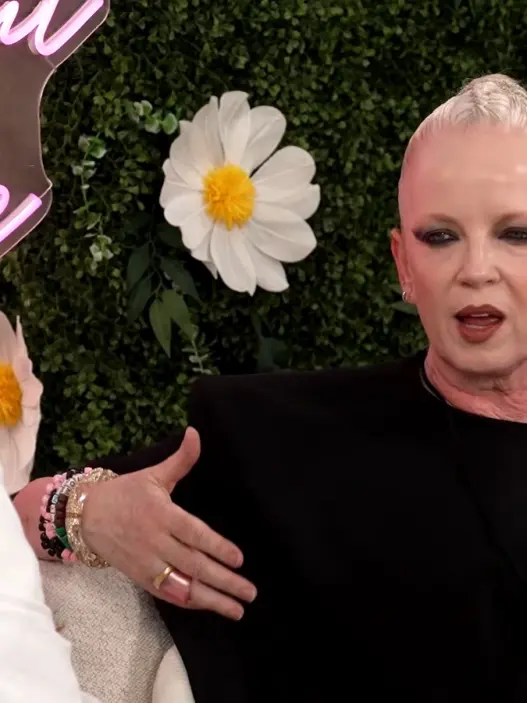
Nick Rhodes Reflects on Nearly 50 Years of Duran Duran
Interview stills from Nick Rhodes’ wide-ranging conversation about the band, its influences, image and extraordinary longevity.
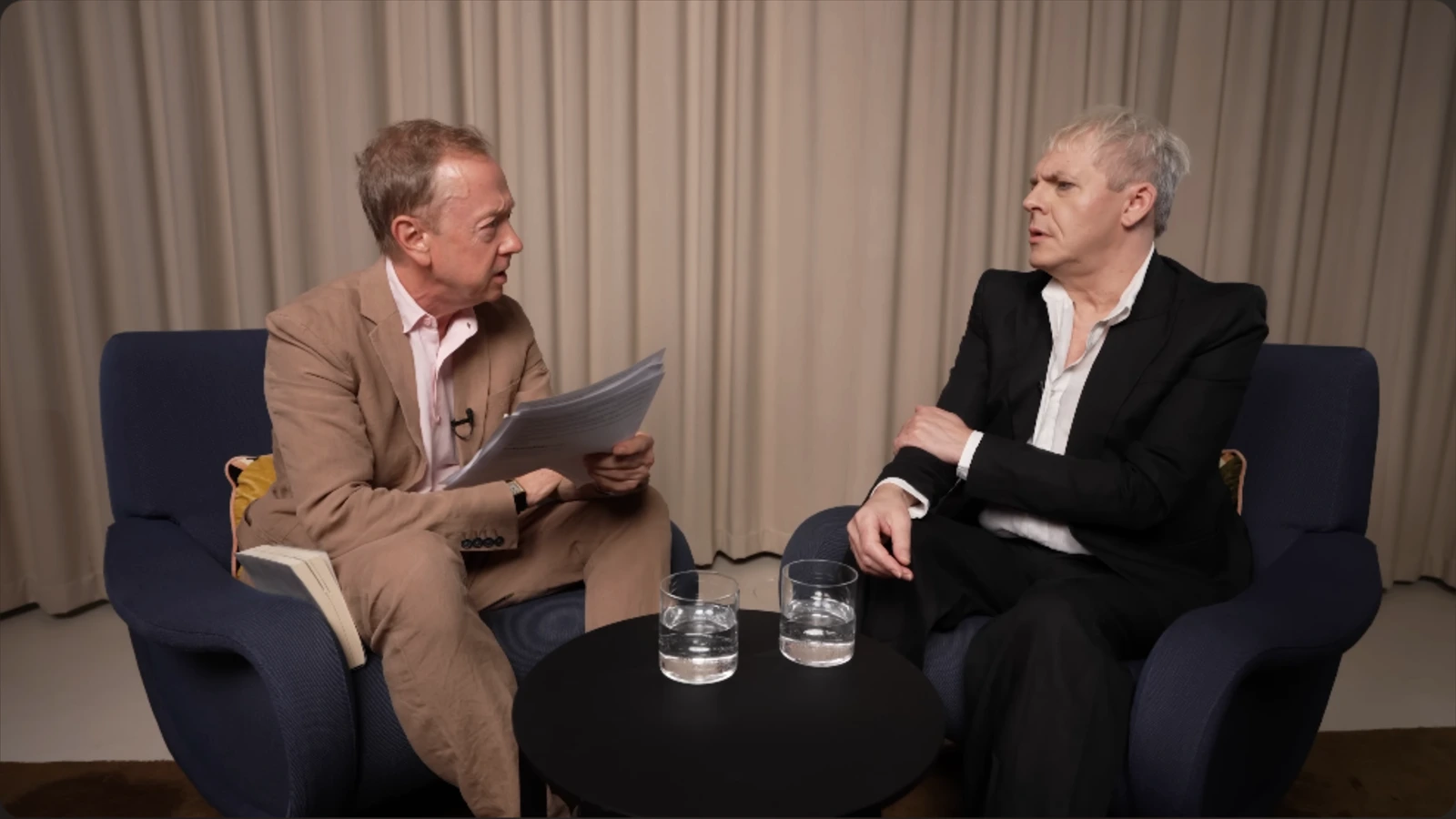
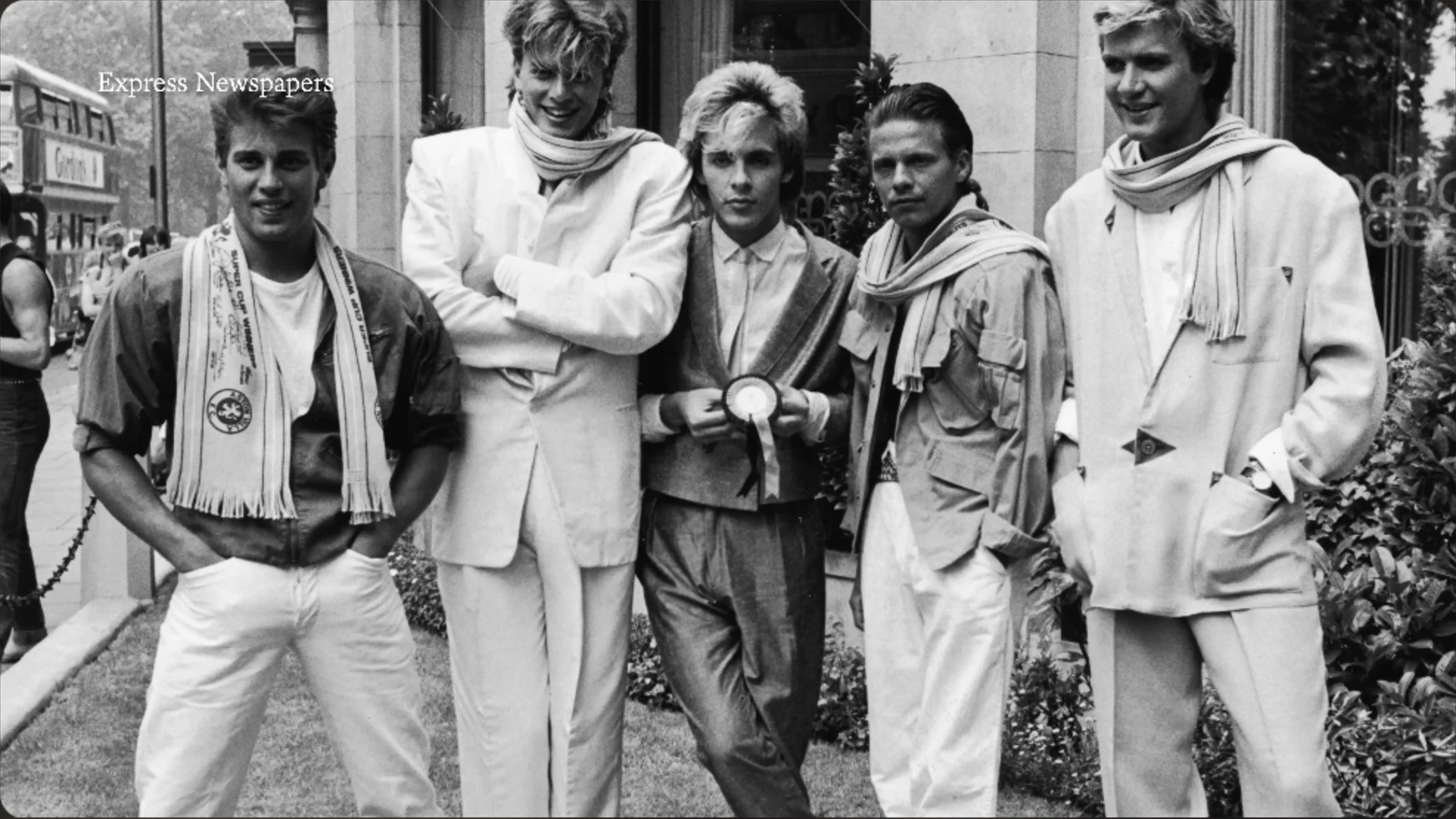
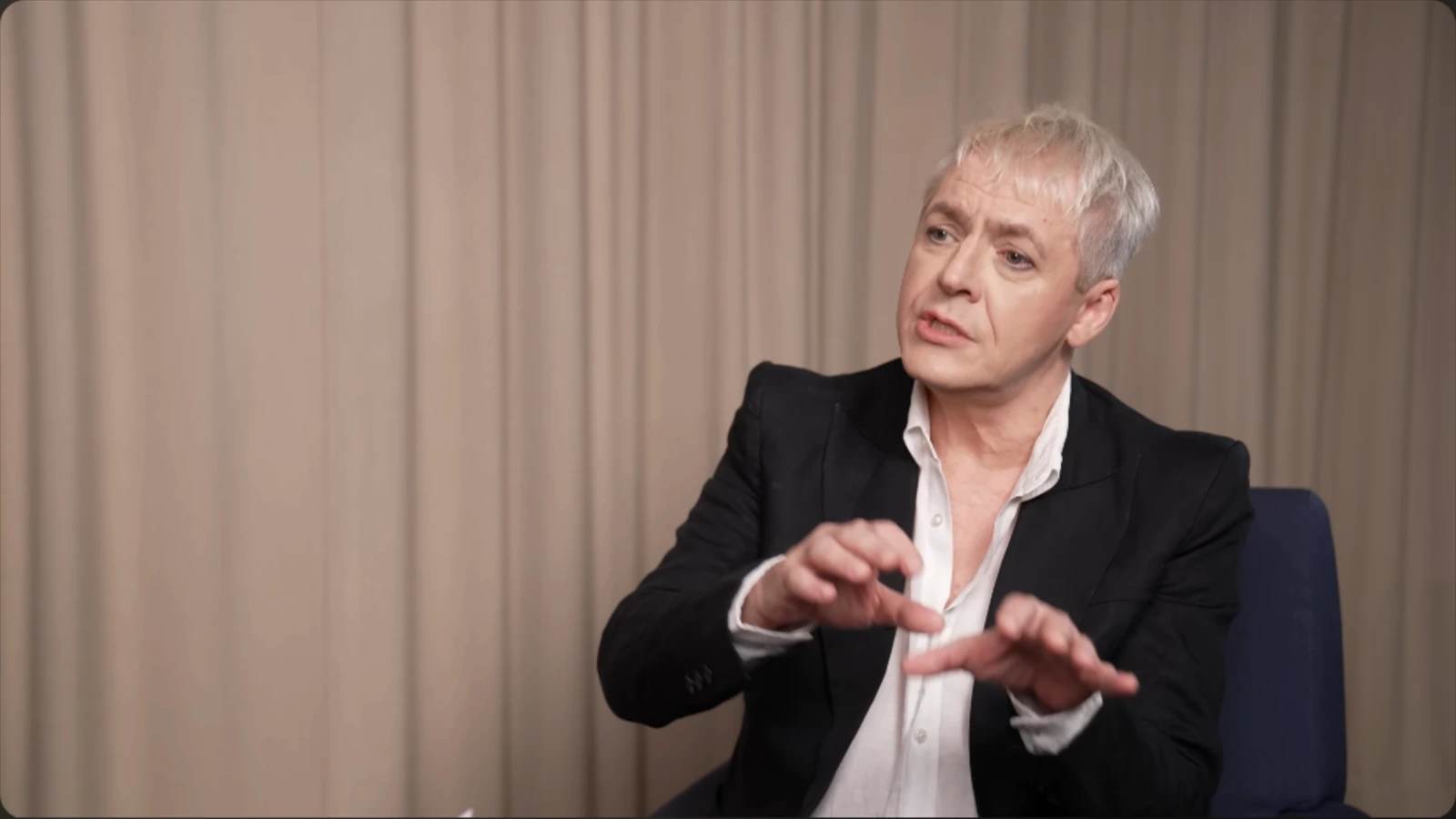
Nick Rhodes discusses Duran Duran’s survival, creativity and visual legacy. Images: The Independent / YouTube.
Watch Nick Rhodes’ Full Interview on Duran Duran, Bowie and Mick Jagger
In the full conversation for The Independent, Rhodes also discusses Andy Warhol, Princess Diana, “Electric Barbarella,” his fashion archive, synthesizers and why the world still needs bands.
Sources: The Independent; Duran Duran.