














The tiny animal with an enormous survival trick.
Meet Mister Tardigrade. Or is it Water Bear? Perhaps Moss Piglet?
Whatever adorable name you choose, the tardigrade is a microscopic animal that looks as though it should be kneading a very tiny blanket while quietly preparing to outlast nearly everything around it.
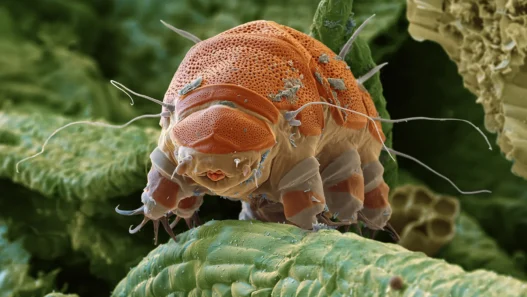
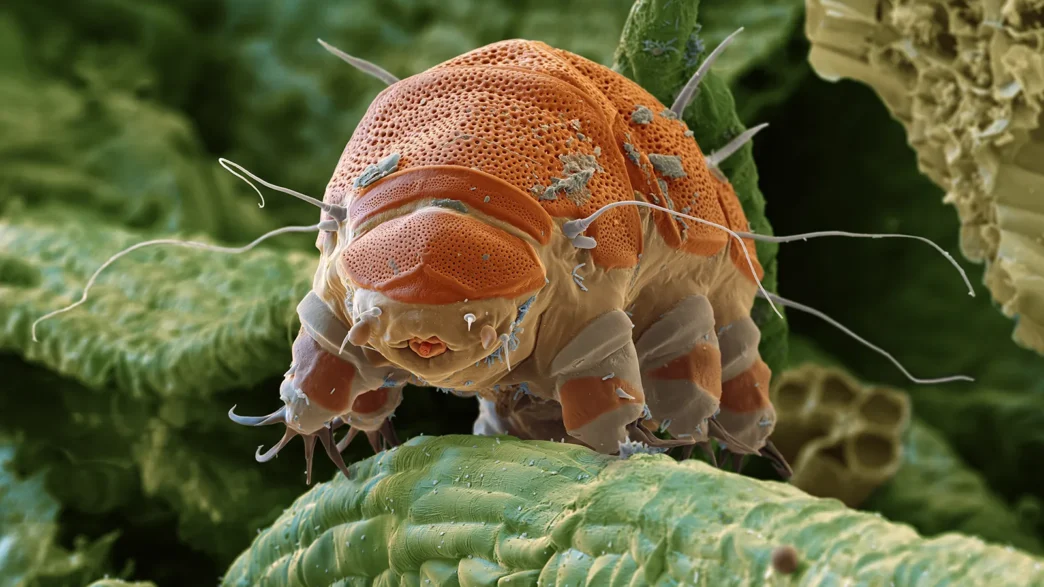
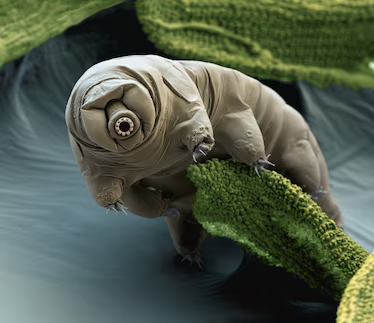
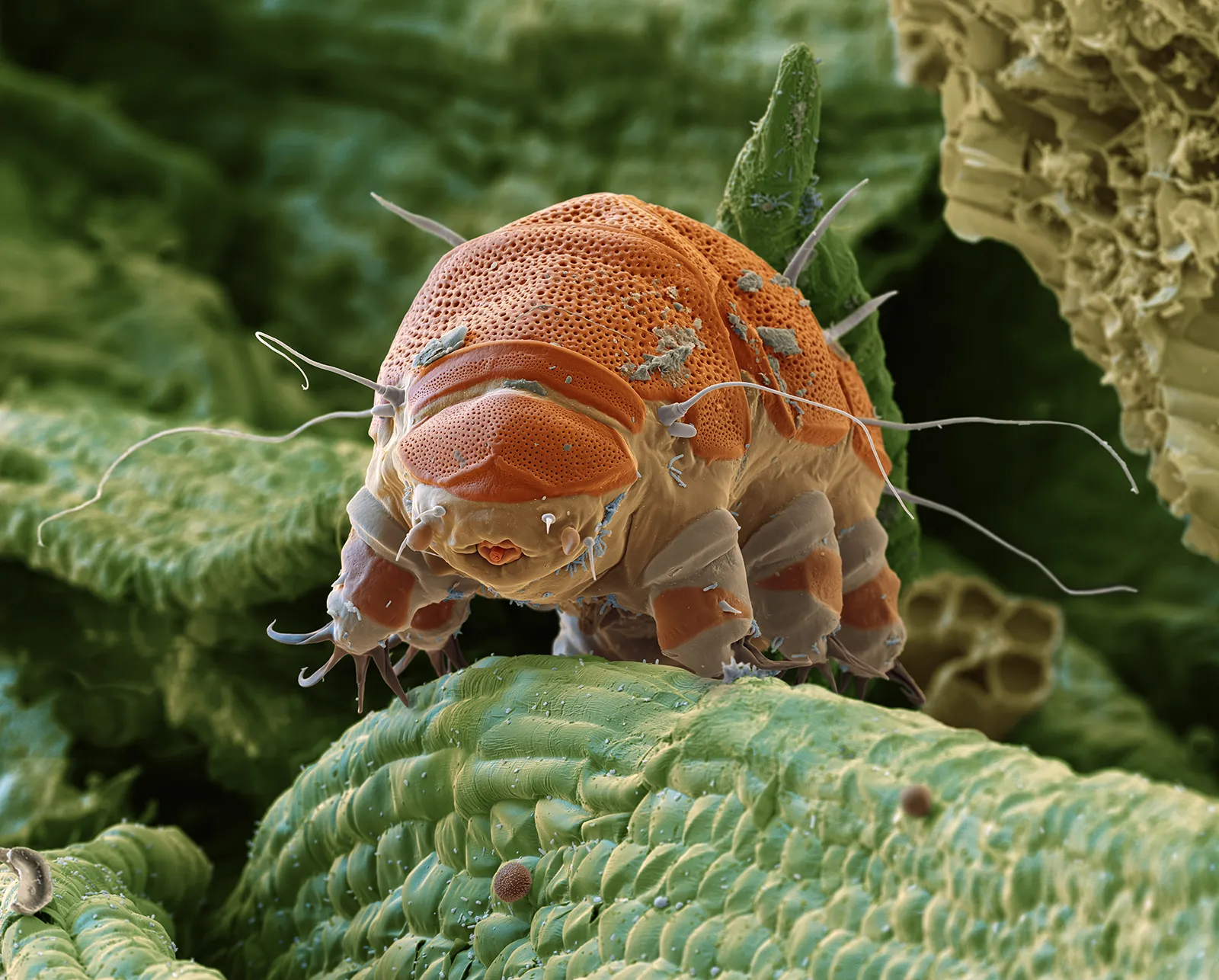
Under magnification, its plump segmented body, circular mouth and eight stubby legs give it the appearance of a science-fiction teddy bear moving through an invisible jungle.
In reality, tardigrades are usually only about half a millimeter long. They move and groove through the thin layers of water surrounding moss, lichen, soil, algae and other damp environments found in everyday places.
You could be standing beside an entire water-bear neighborhood and never know it without a microscope.
Explore the hidden wildlife living inside moss and discover how water bears survive when their environment disappears.
As an Amazon Associate, INYIM Media earns from qualifying purchases.
What exactly is a tardigrade?
A tardigrade is a microscopic eight-legged invertebrate belonging to the animal group Tardigrada.
Scientists have identified roughly 1,300 species living across the planet, from freshwater moss and forest lichen to oceans, mountains, deserts, hot springs and polar environments.
Despite their reputation for toughness, active tardigrades still need moisture. A thin film of water allows them to move, feed and carry out their everyday water-bear business.
The nickname comes from their slow, lumbering gait and rounded body. Each of their four pairs of legs ends in tiny claws used to grip moss, algae and other surfaces.
They also possess specialized mouthparts that pierce plant cells, algae and microorganisms before sucking out the nutrients inside.
So yes, he may look like he is making biscuits. He is more likely holding onto moss while locating lunch.
The secret is becoming a tiny dried-up ball.
The tardigrade’s greatest survival move begins when the water surrounding it disappears.
Instead of immediately dying from dehydration, many species pull their legs and head inward, lose most of the water inside their bodies and curl into a compact shape called a tun.
Inside this state, their metabolism slows to nearly undetectable levels. Scientists call the process cryptobiosis.
The animal is not comfortably living through the emergency. It is essentially placing ordinary life on hold until conditions become survivable again.
When water returns, the tardigrade can rehydrate, unfold its legs and resume crawling around as though its entire world did not just vanish.
That is less “nothing can hurt me” and more “I will become a microscopic raisin until further notice.”
Yes, water bears have survived exposure to space.
Tardigrades became scientific celebrities after dehydrated specimens were sent into low Earth orbit in 2007.
Some survived direct exposure to the vacuum of space and later revived after returning to Earth.
However, the popular version of the story often leaves out an important detail: exposure to intense ultraviolet radiation substantially reduced their survival.
They are extraordinarily resilient animals—not immortal superheroes.
The tun state has also helped different tardigrade species endure severe dehydration, freezing, high pressure and levels of radiation that would be fatal to most animals.
Researchers are now studying the proteins and biological mechanisms behind that protection to better understand DNA repair, preservation, agriculture, medicine and the possibility of surviving harsh environments beyond Earth.
The irony is that while the dormant form can endure astonishing laboratory conditions, an active tardigrade remains part of an ordinary food web.
Nematodes, amoebas and even other tardigrades may eat them. Prolonged heat can kill them. Their daily lives are far less invincible than their legend suggests.
They are simply very good at waiting out disaster when given enough time to prepare.
Watch the world’s toughest tiny animal.
National Geographic explores how tardigrades move through moss, enter cryptobiosis and survive environmental extremes that would destroy most other animals.
Beyond their extreme survival résumé, there is something joyful about simply watching them walk.
Their tiny legs do not move with the alien efficiency you might expect from such celebrated survivors. They shuffle, wobble and climb with the determined body language of a very small creature carrying several grocery bags at once.
National Geographic’s microscopic footage brings that hidden movement into view, revealing an entire wildlife world contained inside places most of us barely notice.
Dig out Mister Tardigrade—the water bear, moss piglet and microscopic icon—grooving through his natural habitat right below.
See a tardigrade moving under magnification.
National Geographic gives viewers another up-close look at the eight-legged micro-animal ambling through a world too small for the naked eye.
National Geographic shares another magnified look at the tiny eight-legged water bear exploring its hidden world.
Watch on InstagramSources: The official National Geographic video provided the featured footage and overview; National Geographic’s tardigrade guide provided the habitat, anatomy and survival information; the National Geographic Instagram reel provided the additional microscopic footage.