



















McDonald’s Has a Value Problem — And the Numbers Are Hard to Ignore
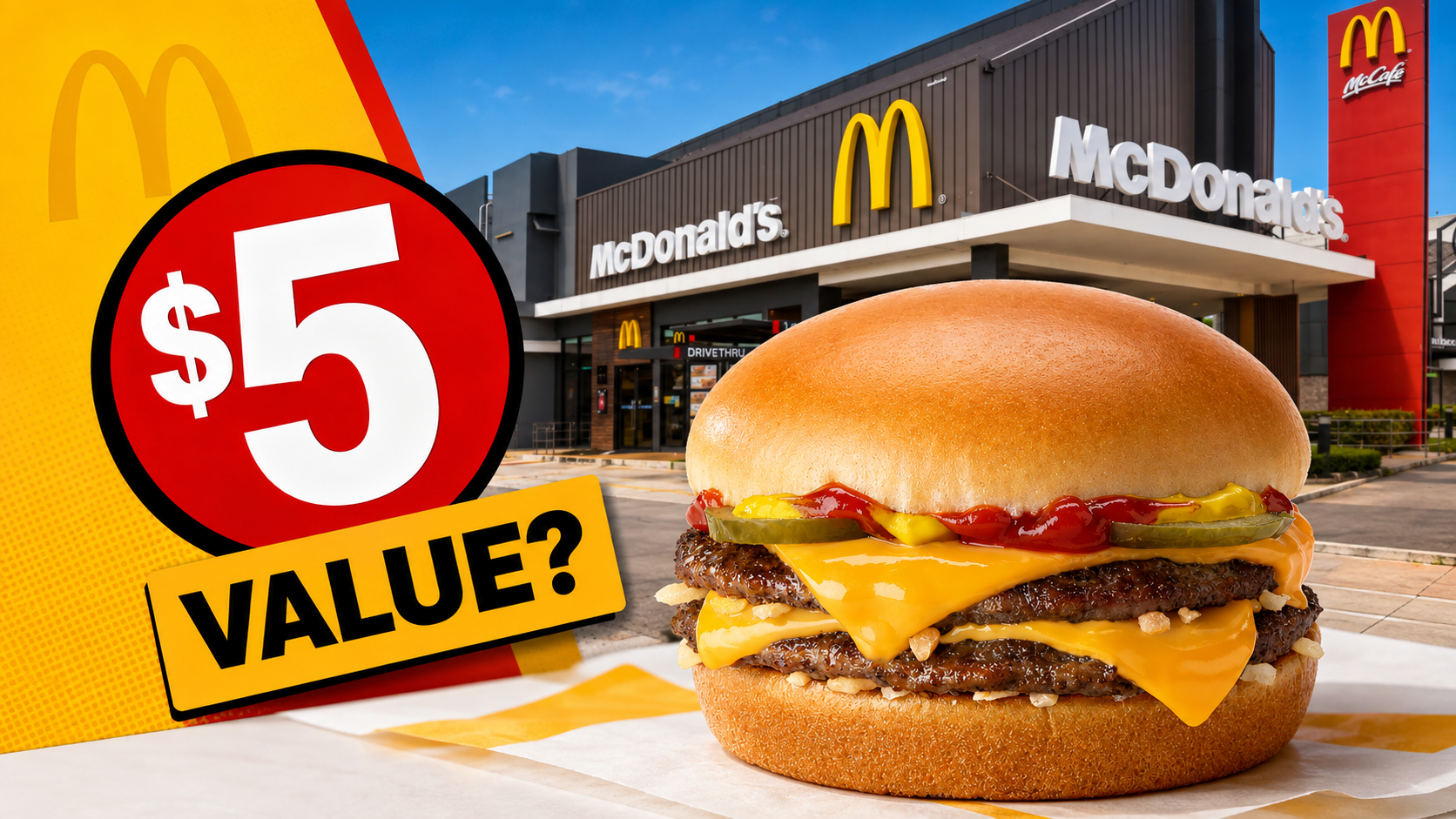
McDonald’s knows it has a problem.
Not a burger problem. Not a fries problem.
A value problem.
After reporting its latest U.S. results, McDonald’s acknowledged that changes to digital deals and problems executing its value strategy hurt visits from some of its most loyal customers. U.S. comparable sales increased just 0.8% in the second quarter of 2026, while comparable guest counts declined.
At the same time, McDonald’s made $2.36 billion in net income during those three months.
Three months.
So when customers say McDonald’s doesn’t feel cheap anymore, maybe the answer shouldn’t simply be another app coupon.
We wanted to look at the money.
How much is McDonald’s actually making? How much are the people running it being paid? Would cutting executive compensation make food cheaper? Where is the money that actually could lower prices?
And the question customers aren’t supposed to ask out loud:
Is some of this just greed?
Discover More
McDonald’s puts the numbers in public view.
Revenue, profit, franchise income and shareholder returns are all laid out in the company’s investor reports and filings.
Some links may be affiliate links. INYIM may earn from qualifying purchases.
First: Yes, McDonald’s Costs Have Gone Up
We aren’t going to pretend inflation never happened.
Food costs increased. Labor became more expensive. Insurance, utilities, supplies, construction and other restaurant expenses increased.
McDonald’s has pushed back against exaggerated claims about its pricing before. In 2024, the company said the average U.S. Big Mac had risen from $4.39 in 2019 to $5.29, a 21% increase, while pointing to inflation and higher operating costs faced by franchisees. McDonald’s published its own breakdown of those increases here.
That’s fair.
And there’s another important piece people sometimes miss: McDonald’s Corporation doesn’t directly operate most McDonald’s restaurants.
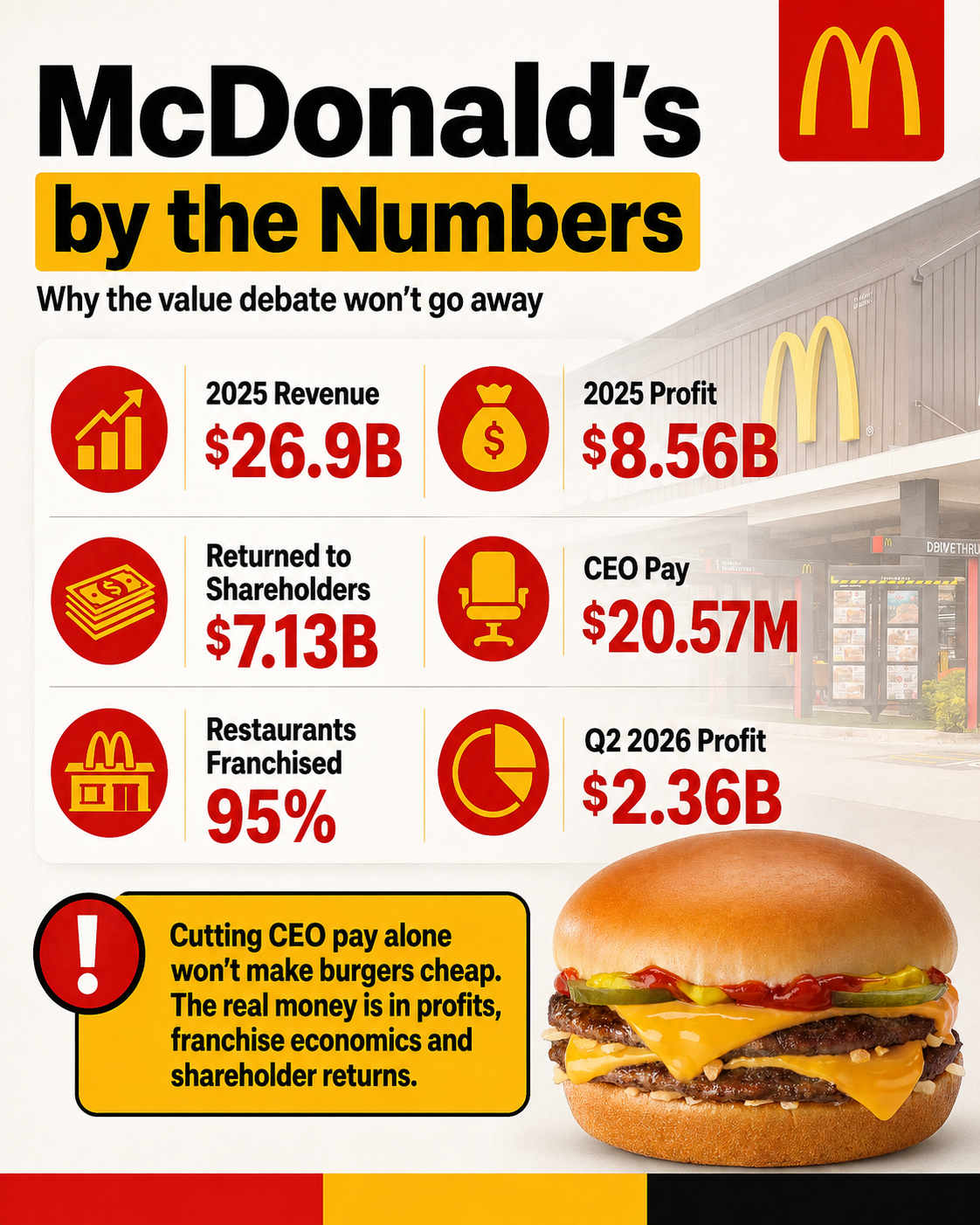
About 95% of McDonald’s restaurants are independently owned and operated, and franchisees generally set their local menu prices.
So no, Chris Kempczinski isn’t sitting in Chicago personally deciding that your neighborhood fries should cost another 40 cents.
But that also doesn’t mean McDonald’s Corporation is an innocent bystander.
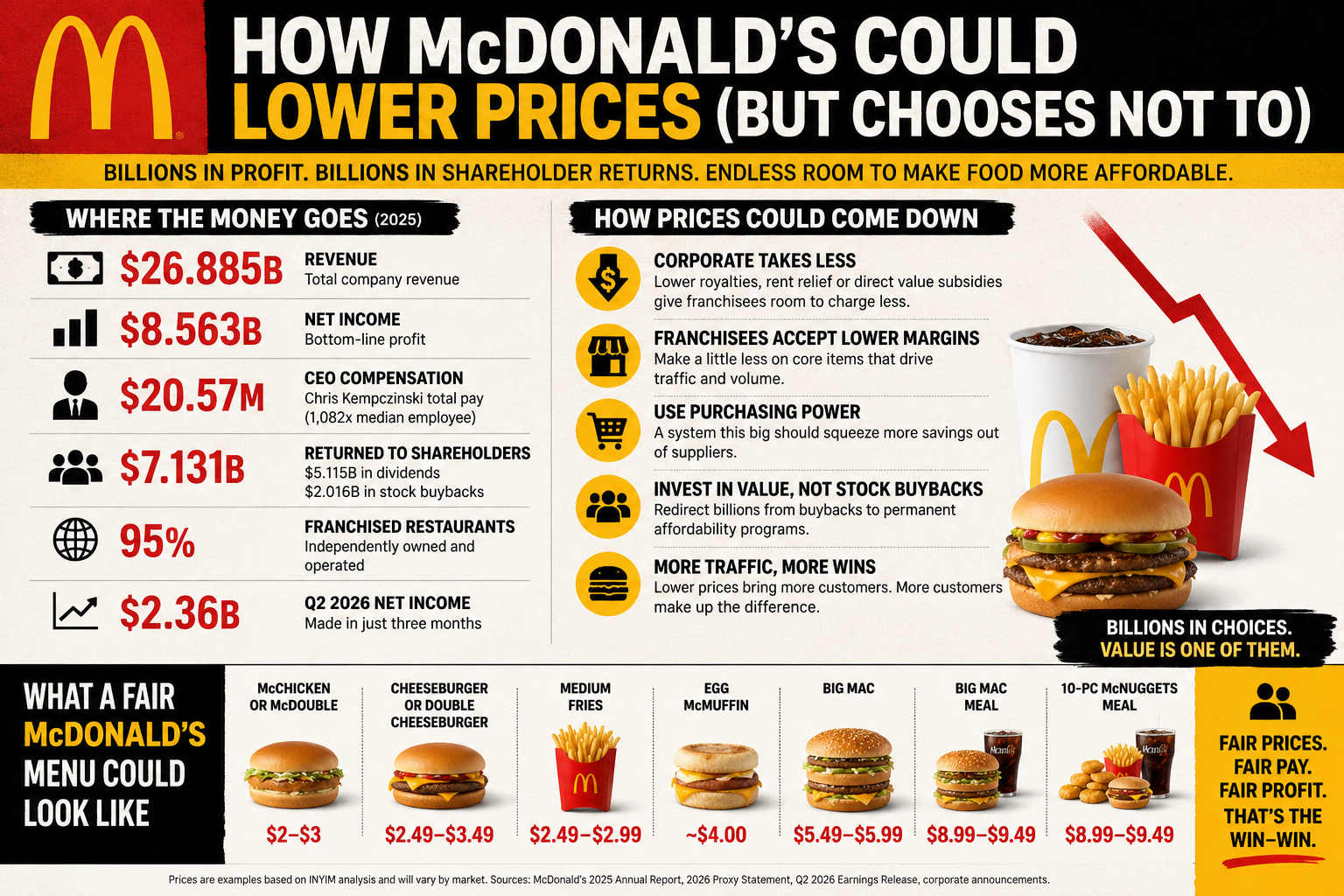
McDonald’s Made $8.56 Billion in Profit Last Year
Here’s the part that makes the affordability conversation harder to dismiss.
McDonald’s Corporation reported $26.885 billion in revenue in 2025.
Operating income was $12.393 billion.
Net income — the bottom-line profit after expenses — was $8.563 billion.
Across the entire McDonald’s system, including franchised restaurants, sales reached $139.4 billion in 2025.
This isn’t a company desperately trying to keep the lights on.
McDonald’s is enormously profitable.
And that brings us to where some of that money went.
McDonald’s Sent More Than $7 Billion Back to Shareholders
In 2025, McDonald’s returned $7.131 billion to shareholders.
That included approximately $5.115 billion in dividends and $2.016 billion buying back McDonald’s stock.
Put that next to the company’s $8.563 billion in annual net income and the amount returned to shareholders was equal to roughly 83% of that year’s profit.
Now, dividends and stock buybacks aren’t illegal, unusual or automatically bad. Public companies exist partly to produce returns for investors.
But let’s stop pretending they’re not choices.
McDonald’s chose to spend more than $2 billion buying its own stock.
That money could also have been used for franchise relief, permanent national value pricing, restaurant improvements, employee compensation or some combination of those things.
It wasn’t.
Shareholders got it.
That’s relevant when customers are being told that affordable food is increasingly difficult to deliver.
And Then There’s That $20.6 Million CEO Package
McDonald’s CEO Chris Kempczinski received $20,574,525 in total compensation for 2025.
That figure includes much more than salary. Executive compensation packages include stock awards, options, incentives and other compensation.
McDonald’s own 2026 proxy statement calculated Kempczinski’s compensation at 1,082 times that of its median employee, whose annual compensation was $19,020.
Think about $20.57 million for a second.
- About $1.71 million per month.
- About $396,000 per week.
- About $56,000 for every day of the year.
Does one person need $20.6 million a year to live comfortably?
No.
There is no reasonable definition of comfortable living in which someone needs another million dollars every few weeks.
At that level, compensation isn’t about paying someone’s mortgage, buying groceries or making sure retirement is secure.
It’s wealth accumulation.
McDonald’s can argue — as virtually every major public corporation does — that enormous compensation packages are necessary to attract executives, reward performance and align management with shareholders.
Fine.
Customers are still allowed to ask whether the scale has become absurd.
And Kempczinski isn’t alone.
McDonald’s five named top executives for 2025 received approximately $45.9 million in total compensation combined, according to the company’s compensation disclosures.
That’s a lot of money.
But here’s where we refuse to play the easy game.
Cutting the CEO’s Pay Would NOT Make Your Big Mac Cheap
Suppose McDonald’s decided that $1 million a year was enough for its CEO.
Kempczinski could still be extraordinarily wealthy, and McDonald’s would save approximately $19.6 million annually.
Sounds huge.
For one person, it is.
For McDonald’s, it isn’t.
More than two million people work in McDonald’s franchised restaurants around the world.
Spread that $19.6 million among two million workers and you’re talking about less than $10 per worker for an entire year.
That isn’t a raise.
That’s lunch.
Cut all five of those named executives down to $1 million each and you’d save roughly $40.9 million.
Spread that across two million workers and it’s around $20 per person per year.
That’s not a meaningful raise.
And spread across McDonald’s enormous volume of customer transactions, it would barely touch menu prices.
So we’re not going to tell you the usual social-media fairy tale that the CEO could take less money and suddenly everyone gets $2 Big Macs.
The numbers don’t support it.
Executive compensation is a fairness and priorities problem. It is not the main reason your food costs so much.
The really big money is elsewhere.
The Franchise Machine Is Where the Numbers Get Serious
McDonald’s business model is incredibly profitable partly because most of its restaurants are franchised.
In 2025, U.S. franchised McDonald’s restaurants generated approximately $51.946 billion in sales.
McDonald’s Corporation recorded $7.371 billion in U.S. franchised revenue, including the rent and royalty streams generated through that franchise system.
Its U.S. franchised restaurant margin was approximately $6.078 billion.
Now we’re talking about billions.
McDonald’s itself says franchised margins represent approximately 90% of its restaurant margin dollars.
That’s important because it shows where the real financial power is.
McDonald’s Corporation doesn’t need to own every grill to make enormous amounts of money from the restaurants underneath the Golden Arches.
The company makes money when franchisees make sales.
Franchisees need enough money to cover food, employees, utilities, insurance, local costs and their own profit.
McDonald’s Corporation takes its piece.
Investors expect theirs.
And the customer pays the bill that feeds the entire system.
So if McDonald’s seriously wants lower menu prices, the solution has to come from more than the customer.
What Would Actually Make McDonald’s Cheaper?
Corporate could accept less.
Franchisees could accept slightly lower margins on certain high-volume core items.
McDonald’s could provide more financial support for nationally advertised value meals so franchise operators aren’t expected to carry the entire discount.
The company could use some of the billions currently allocated to share repurchases for permanent affordability programs.
Its enormous purchasing scale could be pushed harder to reduce food, packaging and operating costs.
And McDonald’s could return to the equation that helped build the company in the first place:
Make a little less on each customer and get more customers through the door.
That’s not charity.
That’s business.
McDonald’s itself just provided evidence that lower pricing is possible.
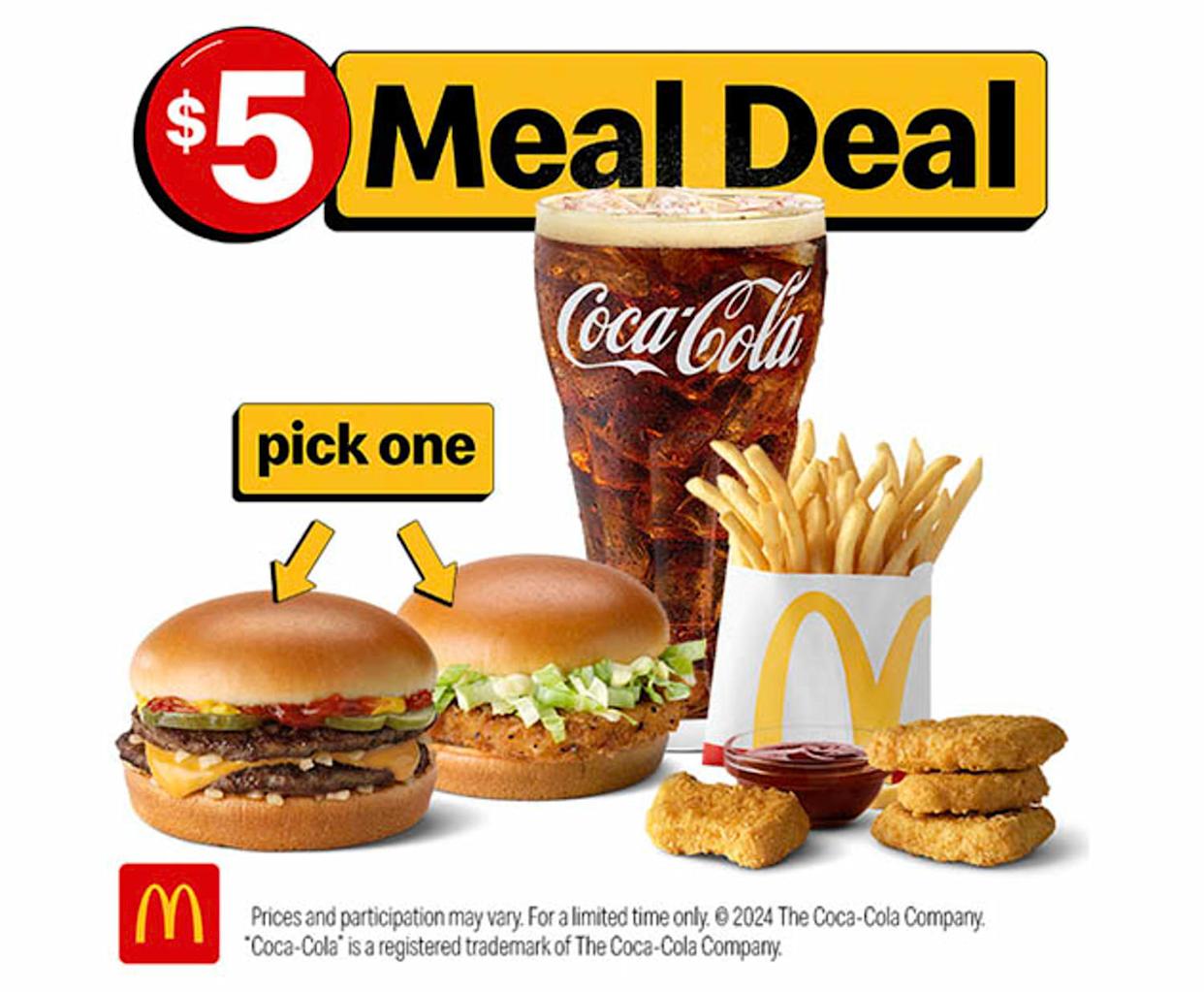
Its revamped 2026 McValue menu includes items such as the McChicken, McDouble, four-piece McNuggets, small fries and medium soft drinks for under $3 at participating locations, along with a $4 breakfast meal, $5 McChicken Meal Deal and $6 McDouble Meal Deal. Prices and participation can vary by restaurant.
So when somebody says McDonald’s simply cannot offer inexpensive food anymore, we’re not buying that argument.
McDonald’s is offering inexpensive food right now.
The question is why affordable pricing has to be carved into special menus, bundles, app promotions and temporary offers instead of being the normal expectation again.
McDonald’s Just Put a New President in Charge of America
And the timing here couldn’t be better.
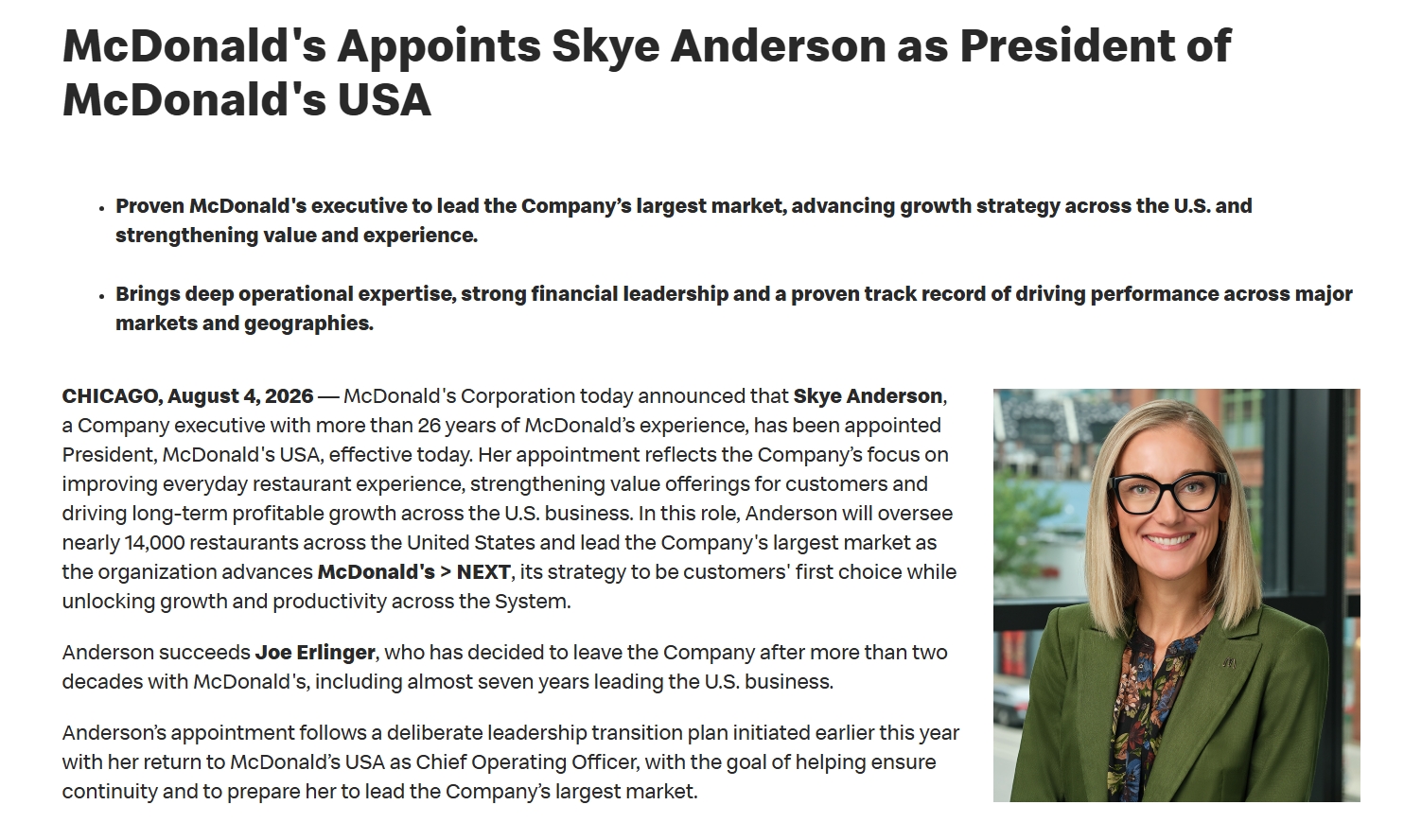
On August 4, 2026, McDonald’s appointed Skye Anderson as President of McDonald’s USA, replacing Joe Erlinger.
Anderson isn’t some outsider McDonald’s found yesterday. She’s been with the company for more than 26 years, has worked across finance and operations, and most recently served as Chief Operating Officer of the U.S. business.
She now oversees nearly 14,000 U.S. McDonald’s restaurants. McDonald’s announced Anderson’s appointment here.
More interesting is how McDonald’s described her job.
The company specifically said Anderson’s appointment reflects its focus on improving the restaurant experience, strengthening value offerings for customers and driving long-term profitable growth.
Good.
Because that’s the assignment.
Not another confusing promotional maze.
Not an app offer that disappears next month.
Not a press release telling customers McDonald’s still represents value.
Make the value visible on the menu board.
Anderson has experience with the numbers. McDonald’s says that while running its U.S. West Zone, covering more than 5,700 restaurants, comparable sales rose more than 30% over four years and average restaurant cash flow increased by $100,000.
Now let’s see whether that financial skill can benefit customers too.
So What Should McDonald’s Really Cost?
Nobody outside McDonald’s and its franchise system has access to the complete cost structure of every burger sold in every market.
We’re not going to invent a fake “true cost” and pretend we found a secret spreadsheet.
Los Angeles isn’t rural Kansas. Manhattan isn’t Alabama. Labor, rent and taxes vary.
But we can still establish what we think a fair McDonald’s should look like: employees are paid properly, franchisees make money, McDonald’s Corporation remains hugely profitable and investors still get a return — just without squeezing maximum dollars out of every order.
Our target would look roughly like this:
- Big Mac: $5.49–$5.99
- Quarter Pounder with Cheese: $5.49–$5.99
- McChicken or McDouble: $2–$3
- Medium fries: $2.49–$2.99
- Egg McMuffin: around $4
- Big Mac Meal: about $8.99–$9.49
- 10-piece McNuggets Meal: about $8.99–$9.49
High-cost markets could reasonably charge more.
Those aren’t claimed break-even prices. They’re an INYIM fair-value benchmark based on what McDonald’s historically represented, what it currently demonstrates it can sell through McValue, and the enormous scale and profitability of its system.
Nobody is asking McDonald’s to bring back 1980s prices.
We’re asking why a basic fast-food meal ever needs to start competing with what people expect to pay at a casual sit-down restaurant.
So Is It Greed?
Here’s where we don’t sugarcoat it.
If by “greed” we mean McDonald’s raised every price for no reason whatsoever, then no.
That would be dishonest.
Costs went up.
Franchisees have legitimate expenses.
Employees deserve decent wages.
Suppliers have to get paid.
But if greed means constantly asking how much more money can be extracted from the system while still keeping customers coming back, then the question becomes much harder for McDonald’s to brush aside.
Because McDonald’s made $8.56 billion in profit last year.
It returned $7.13 billion to shareholders.
Its CEO received $20.57 million in compensation.
And in the latest quarter, even as U.S. guest counts fell and the company acknowledged problems with its value strategy, McDonald’s still made $2.36 billion in three months.
The problem isn’t that McDonald’s makes money.
It’s supposed to.
The question is how much is enough?
Would McDonald’s suddenly become an unhealthy company if annual profit were $7.5 billion instead of $8.5 billion?
Would investors survive slightly fewer stock buybacks?
Could corporate take a little less from the franchise system?
Could franchisees make slightly less on certain products in exchange for greater traffic?
Could the CEO somehow get through the year on a few million dollars?
We think the answers are pretty obvious.
And that’s why cutting the CEO’s compensation isn’t our solution. It’s merely one very visible example of where McDonald’s priorities currently sit.
The serious money is in billions of dollars of profit, franchise margins and shareholder returns.
That’s where enough money exists to actually move prices.
McDonald’s Doesn’t Need to Become Cheap. It Needs to Become McDonald’s Again.
There’s something almost strange about watching one of the companies that helped define inexpensive American fast food now spend so much energy convincing customers that it still offers value.
McDonald’s shouldn’t need a complicated explanation.
People should be able to walk in, order a burger, fries and drink, look at the total and think:
Yeah. That’s reasonable.
The company appears to understand that.
It has revamped McValue. It admits its recent execution hurt loyal customers. It just installed a new U.S. president with strengthening value explicitly included in her mandate.
So now do it.
Pay employees fairly.
Let franchisees make money.
Make billions in profit.
Pay the executives extremely well.
Give shareholders their return.
But somewhere in that equation, remember the person actually buying the food.
Because after $139.4 billion in annual systemwide sales, $8.56 billion in corporate profit and $7.13 billion sent back to shareholders, telling customers there simply isn’t room to make McDonald’s more affordable becomes a much harder argument to swallow.
Maybe customers aren’t asking McDonald’s for too much.
Maybe they just want McDonald’s to be its old self again. Somebody call Ronald!
Watch McDonald’s “Calvin Got a Job” Commercial From 1990
The vintage ad captures the affordable, everyday image McDonald’s built much of its American identity around.
Sources
- MSN — “McDonald’s Admits Pricing Mistakes and Pulled Offers Alienated Its Most Loyal Customers” — original news peg
- Reuters — McDonald’s U.S. sales growth slows as value push falters
- McDonald’s Q2 2026 Earnings Release
- McDonald’s 2025 Annual Report and SEC Form 10-K
- McDonald’s 2025 Annual Report — Official McDonald’s PDF
- McDonald’s 2026 Proxy Statement
- McDonald’s — “Providing Meaningful Value to Our Fans, With a Side of Facts”
- McDonald’s USA — 2026 McValue and Under-$3 Menu Announcement
- McDonald’s — Skye Anderson Named President of McDonald’s USA
- McDonald’s Investor Relations