

















Neil deGrasse Tyson Puts Hollywood’s Favorite Space Fantasies on Trial
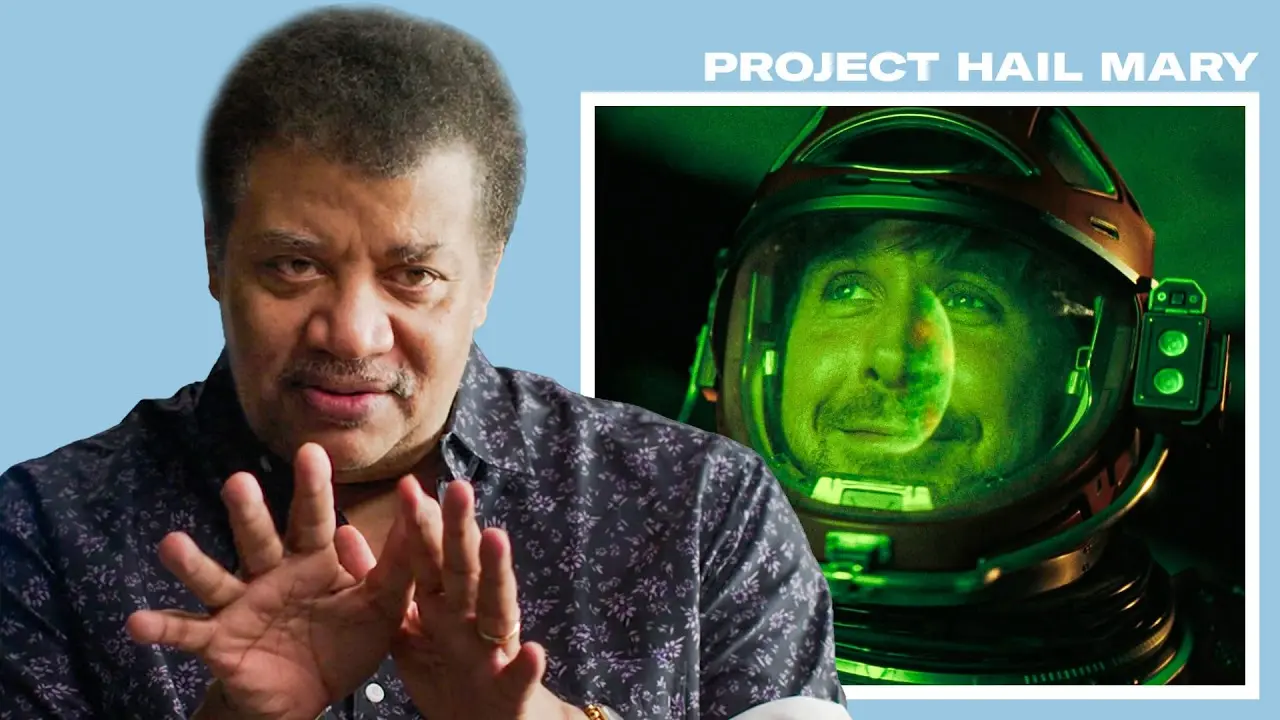
Author, astrophysicist and resident science master Neil deGrasse Tyson is back doing one of his favorite things: putting Hollywood under the microscope. This time, he rewatches 16 sci-fi films for GQ and sorts through what the movies get right, what they get hilariously wrong, and what he is perfectly willing to forgive in the name of a good story.
And yes, some of the biggest names in science fiction are on the exam. Tyson jumps from The Day After Tomorrow and The Martian to Interstellar, Back to the Future, Star Wars, Alien, Jurassic World, Project Hail Mary, The Avengers and Tenet. It is basically a nearly hour-long fact check of our collective space-movie education.
Discover More
Science Fiction, But Make It Factual
Neil deGrasse Tyson separates thee good science from Hollywood’s beautifully entertaining nonsense.
Some links may be affiliate links. INYIM may earn from qualifying purchases.
Tyson is not approaching this like the fun police, either. One of the recurring pleasures of the segment is watching him separate bad science from good filmmaking. He can point out a broken law of physics and still admit the scene works. That distinction matters, because the best moments here are not about proving a movie “wrong.” They are about understanding the real science well enough to appreciate exactly where the filmmakers decided to bend it.
The Martian earns some of Tyson’s highest praise. He calls it one of the most scientifically accurate sci-fi films ever made, even while flagging specific problems with how its space rescue mechanics play out. He is similarly complimentary toward Interstellar, whose physics pedigree is unusually serious thanks to physicist Kip Thorne’s involvement. Tyson uses the film to explain gravitational time dilation, black holes and why general relativity is not just some theoretical bit of science-fiction seasoning.
Then there is Star Wars, where Tyson more or less waves a white flag before the analysis even begins. His advice is simple: do not watch Star Wars for the science. He still cannot resist getting into BB-8 rolling over sand, lightsabers behaving like solid objects, and the rather obvious problem of TIE fighters making noise in the vacuum of space. The movies survive. Science survives. Everybody goes home happy.
His breakdown of Alien gets especially interesting because Tyson shifts away from pure physics and into biology and psychology. He notes that Hollywood aliens are often strangely humanoid despite the enormous variety of life already found on Earth. Then he gets into why the Xenomorph remains so effective: apparently one of cinema’s greatest primal fears is not simply dying, but being eaten. Suddenly all those teeth make even more sense.
Tyson also gives Christopher Nolan plenty of respect, especially when discussing Tenet. He acknowledges that the film’s manipulation of time is deliberately mind-bending, but praises the sheer cinematic challenge of turning those ideas into something viewers can actually see and follow. By the end of the segment, Tyson lands on the ideal rule for science fiction: know the facts first, then distort them at your leisure. That may be thee healthiest possible relationship between science and Hollywood.
Watch Neil deGrasse Tyson Break Down 16 Sci-Fi Movies for GQ
The nearly 50-minute edition of GQ’s The Breakdown covers films from The Day After Tomorrow and Interstellar through Project Hail Mary and Tenet.
Source: GQ / The Breakdown.