









Donatella Versace Wants the Egos Back — and Fashion Less Boring
Donatella Versace has a problem with fashion right now: not enough ego, not enough personality and far too much seriousness. In a wonderfully loose interview with Jo-Ann Furniss for LOVE magazine’s Fashion Icons issue, the Versace designer makes the case for bringing back the kind of larger-than-life models who once made a runway feel like an event instead of a procession.
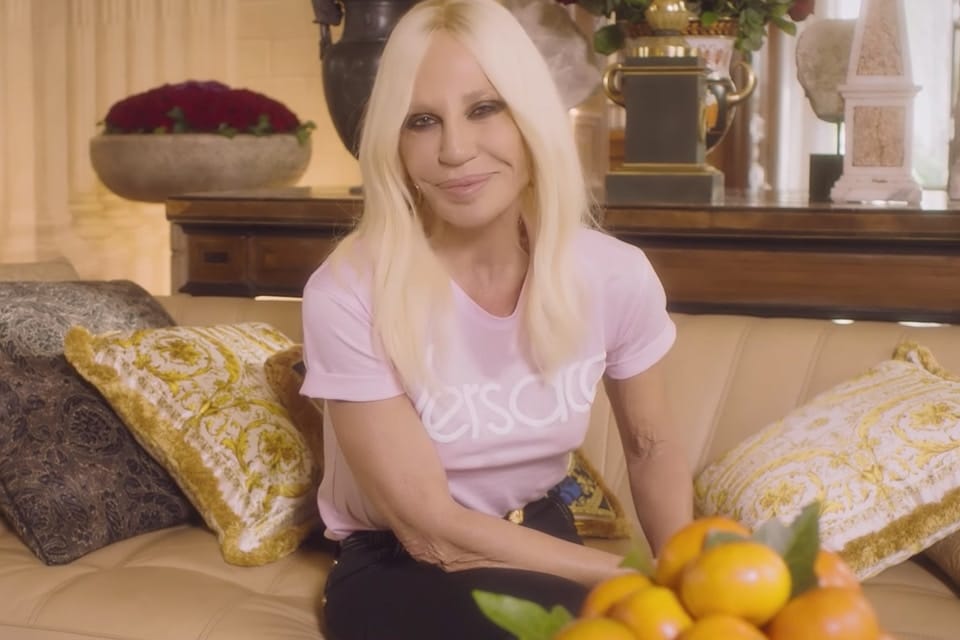
The setting is Donatella’s apartment in Milan, and the conversation quickly turns into something close to a Versace manifesto. She misses the era when a model’s personality could be as memorable as the clothes, when backstage drama was part of the mythology, and when fashion was allowed to be glamorous, funny, excessive and occasionally ridiculous.
Yes, there may be quite a bit to read here, but when you’re in the right space, take a shot at it. It’s quite the amusing article.
Discover More
Inside the Versace Supermodel Era
Donatella Versace looks back at the personalities, campaigns and runway moments that helped make the supermodel era larger than life.
Some links may be affiliate links. INYIM may earn from qualifying purchases.
When Models Became Super
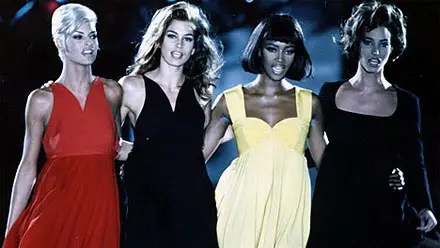
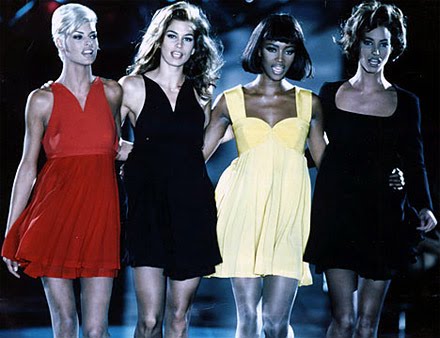
Donatella points back to Gianni Versace’s now-legendary Autumn/Winter 1991 runway show, when Christy Turlington, Linda Evangelista, Cindy Crawford and Naomi Campbell walked together to George Michael’s “Freedom! ’90.” George Michael was sitting in the audience, the print girls had crossed onto the runway, and the collision of fashion, celebrity and pop culture became one of those moments that seemed to change the temperature of the entire industry.
What sometimes gets lost in the mythology is Donatella’s role in pushing Gianni toward those famous faces. At the time, some designers worried that a model with too much fame might overwhelm the clothes. Donatella’s logic was the exact opposite: “Fame on fame means more fame!”
That philosophy became one of the house’s great strengths. The Versace image was never simply about a dress hanging correctly on a body. The model, the photographer, the styling, the runway, the celebrity audience and the campaign all became part of the same spectacle. Personality did not distract from the fashion; it charged it.
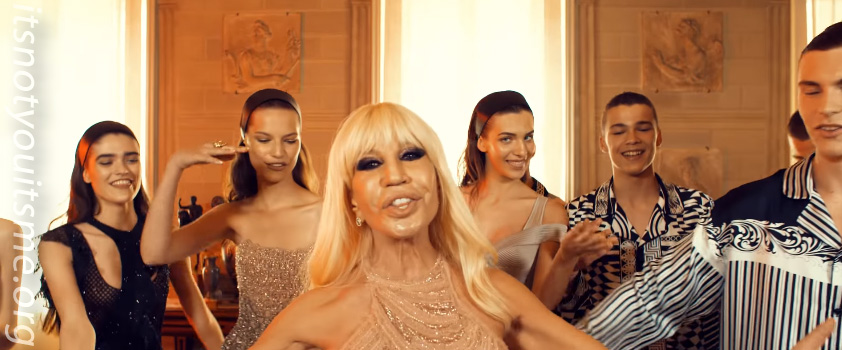
And personality is exactly what Donatella feels the current crop of models is missing. She is unimpressed by blank expressions, minimal makeup and the idea that looking neutral automatically makes fashion more intelligent. For her, the roots of fashion are fun. Remove the joy and the fantasy, and something essential disappears with it.
Kristen, Linda, Kate and the Backstage Wars
The best parts of the conversation arrive when Donatella starts reminiscing about the second wave of supermodels: Kristen McMenamy, Kate Moss and Amber Valletta. These were not interchangeable faces. They arrived with opinions, insecurities, rivalries, habits and enough backstage drama to power their own soap opera.
Kristen McMenamy, in particular, seems to occupy a special place in Donatella’s memory. Gianni did not immediately understand her unconventional beauty or unpredictable personality, but Donatella did. She recalls the endless stories surrounding Kristen and Linda Evangelista, including one gloriously absurd dispute over which model had first appeared with dark roots under blonde hair. Hairdressers and colorists in New York were apparently consulted, and Donatella was dragged in as a witness.
Another backstage story involves Linda preparing to walk and discovering that one of the inserts she used beneath her clothes had disappeared. Chaos followed. Donatella remembers Kristen as the likely culprit, while Gianni essentially told his sister that if she enjoyed managing all these giant personalities so much, she could deal with the consequences.
That is the point Donatella keeps returning to: those quirks were not flaws to be erased. They were part of what made the women compelling. The goal was never to flatten them into one house-approved ideal. It was to figure out who each model already was and turn the volume up.
Kate Moss arrived in that world as a teenager, physically tiny beside some of the established supermodels and suddenly surrounded by women who already seemed larger than life. Donatella recalls booking her for a Richard Avedon shoot when Kate was still just 16. The contrast was exactly what made her interesting: another distinct personality entering the Versace universe rather than being reshaped to resemble everyone already there.
Donatella Was Never Just the Muse
The interview also pushes back on one of the easiest ways Donatella’s early role at Versace has been simplified. She has often been described as Gianni’s muse, a label she has never particularly enjoyed. The relationship was far more combative and creatively useful than that.
She describes herself as the person who would tell her brother when she thought something was wrong. They argued. She contradicted him. He shouted back. Yet the friction was productive, helping shape the attitude around the clothes, the casting and the image of the house.
That influence extended to Versace’s campaigns and books as well. Alongside her former husband Paul Beck, Donatella worked on styling and art direction, while the house collaborated with photographers including Richard Avedon, Irving Penn, Bruce Weber and Helmut Newton. Versace understood early that fashion photography, celebrity, runway theater and the garment itself could all strengthen one another.
The result was an image-making machine that helped establish its own modern pantheon of glamorous men and women. Fashion became entertainment — something to be watched, collected, discussed and remembered.
Natural? Donatella Would Rather Talk About Vegetables
For all the talk about icons and egos, Furniss also captures why Donatella herself is such an entertaining subject. The famous armor is all there — the platinum hair, the heels, the unmistakable Versace polish — but the person underneath comes across as warm, quick to laugh and perfectly willing to make herself the punchline.
Her feelings about the “natural” look are especially Donatella. She jokes that “natural has something to do with vegetables.” The line is funny because it also sums up her entire fashion philosophy: if you are going to construct an image, why pretend otherwise?
She is similarly uncomfortable when the word “icon” is applied to her personally. Gianni’s career contained moments she is happy to call iconic; judging herself that way is another matter. Yet the irony is obvious. Between her visual identity, her role in shaping Versace’s campaigns and the creative continuity she brought to the house, Donatella has become one of fashion’s most instantly recognizable figures whether she wants the title or not.
Spring/Summer 2010: Georgia Jagger, Testino and Alice in Wonderland
The conversation eventually turns toward the present collection. Donatella is especially proud of the Spring/Summer 2010 Versace campaign starring Georgia May Jagger and photographed by Mario Testino. It is an appropriately high-glamour pairing for a season in which she wants the house to move forward without abandoning the visual vocabulary that made Versace unmistakable in the first place.
The collection revives print and color while pulling inspiration from Alice in Wonderland. Donatella focuses on elements such as the rabbit and the clock, mixing them with baroque references and filtering the whole thing through Versace’s own taste for controlled madness.
Her larger point is that fear is the worst possible response to a difficult economic moment. Safe fashion is not going to make anyone pay attention. She wants energy, freedom and something special enough to justify the fantasy in the first place.
After all the stories about supermodels, missing backstage accessories, platinum roots, Gianni and the constant battle against anything “borrring,” that conclusion feels completely consistent. For Donatella Versace, fashion without nerve simply is not Versace.
Source: Jo-Ann Furniss for LOVE magazine, via The Independent, February 2010. This archived INYIM post was restored and reformatted for readability.