




















The Microscopic Parasite Has A Long Memory And Terrible Timing

What is thee “explosive diarrhea” bug making headlines across the country? Its name is Cyclospora cayetanensis, a microscopic parasite that can contaminate food or water and cause an intestinal illness called cyclosporiasis.
The phrase is alarming because the symptom can be exactly as advertised: frequent, watery and sometimes explosive bowel movements. But the cleanest current picture is more precise than some of the breathless headlines. As of July 9, 2026, the CDC had received reports of 843 domestically acquired cases across 31 states, including 86 hospitalizations and no deaths. Another 343 cases were associated with international travel.

More importantly, health authorities are not describing one giant mystery outbreak with one confirmed source. The CDC says several clusters are under investigation, while the FDA is tracing multiple smaller Cyclospora outbreaks tied to products that have not yet been identified. Same parasite, possibly several separate routes into people’s digestive systems.
Discover More
Food Safety Without The Panic Shopping
No produce gadget can guarantee protection from Cyclospora, but clean handling still matters. Start with the CDC’s official guidance, then keep the basic kitchen tools that support safer produce preparation and storage.
Some links may be affiliate links. INYIM may earn from qualifying purchases.
How Cyclospora Gets From The Environment Into Your Lunch
People become infected after swallowing food or water contaminated with the parasite. In the United States, past outbreaks have frequently been connected to fresh produce, including leafy greens, herbs, berries and peas—but investigators have not named one specific food behind the wider 2026 increase.
The parasite ultimately comes from human fecal contamination. That can reach produce through contaminated irrigation water, pesticide-mixing water, flooding, sewage problems or inadequate sanitation somewhere along the growing and handling chain. Humans are the only known host for the species that causes cyclosporiasis.
Here is one strange detail: Cyclospora usually needs to spend at least one to two weeks outside the body before it becomes infectious. That makes direct person-to-person spread unlikely. This is not generally a bathroom-door-handle situation. The larger concern is contamination that has had enough time in the environment to mature before reaching food or water.
Why Investigators Cannot Simply Fingerprint It Like E. Coli
Cyclospora is harder to connect across cases than many bacterial foodborne illnesses. Public-health laboratories have become very good at using whole-genome sequencing to match one E. coli or Salmonella infection with another. Genetic-linking tools for Cyclospora are still being developed and validated.
Then there is thee parasite’s inconvenient calendar. Symptoms usually begin around one week after infection but can appear anywhere from two days to two weeks or longer. By the time someone becomes sick, gets tested and speaks with investigators, they may be asked to remember every salad, herb, berry, glass of water or swim from several weeks earlier.
Fresh produce also moves quickly. If raspberries eaten weeks ago caused an illness, that exact batch may already be spoiled, discarded and long gone from stores before investigators recognize a pattern. Epidemiologists are left comparing interviews and searching for statistical overlap after much of the physical evidence has vanished.
The Symptoms Can Leave, Return And Start The Misery Again
The signature symptom is prolonged watery diarrhea. Other possible symptoms include loss of appetite, weight loss, stomach cramps, bloating, gas, nausea, fatigue, vomiting, body aches, headache and a low-grade fever. Some infected people never develop symptoms at all.
Untreated illness can last from a few days to more than a month. The particularly rude part is the relapse: symptoms may ease, convince you the nightmare is over, and then return one or more times. Cyclospora apparently believes in an encore nobody requested.
A clinician can test a stool sample, but Cyclospora testing may need to be requested specifically because it is not always included in routine stool panels. The parasite can also be difficult to detect, so multiple samples collected on different days may be needed.
The Drug That Works Contains Sulfa—And That Complicates Things
The treatment of choice is the prescription antibiotic combination trimethoprim-sulfamethoxazole, commonly sold under names including Bactrim, Septra and Cotrim. Most patients respond quickly when the infection is properly diagnosed and the medication is appropriate for them.
People allergic or intolerant to sulfa drugs face a more complicated discussion. The CDC says no highly effective alternative has yet been identified. Depending on the patient and severity, a medical team may consider observation with supportive care, an alternative supported by limited evidence, or carefully supervised desensitization for selected patients. That does not mean everybody with a sulfa allergy should simply stay home and “ride it out” without guidance.
Healthy people can eventually clear the infection without treatment, but the illness may be prolonged and relapsing. People who are immunocompromised or already in poor health face a greater risk of severe or long-lasting illness. Persistent watery diarrhea or signs of dehydration deserve a call to a healthcare provider, not a heroic bathroom vigil.
Do Not Break Up With Fruits And Vegetables Yet
Neither the CDC nor the food-safety expert interviewed by DW News is telling people to stop eating fresh produce. Most fruits and vegetables are not contaminated, and the FDA had not issued a broad consumer warning naming one produce item as the source of the national rise when this story was prepared.
Continue washing fruits and vegetables thoroughly under clean running water before eating, cutting or cooking. Scrub firm produce such as melons and cucumbers with a clean produce brush, remove damaged areas and refrigerate cut or peeled produce promptly. Items labeled prewashed do not need another home rinse.
But washing has limits. It can reduce contamination without reliably removing or killing Cyclospora, and common chlorine-based sanitizers are not especially effective against the parasite. Use normal food-safety habits, follow any specific CDC or FDA advisory that emerges and do not wash produce with soap, bleach or household cleaners.
Inside The Cyclospora Investigation
The complete supplied gallery preserves all four DW News images in their original order, showing Schaffner’s interview, the parasite under magnification, the reported state map and the conversation with host David Levitz.
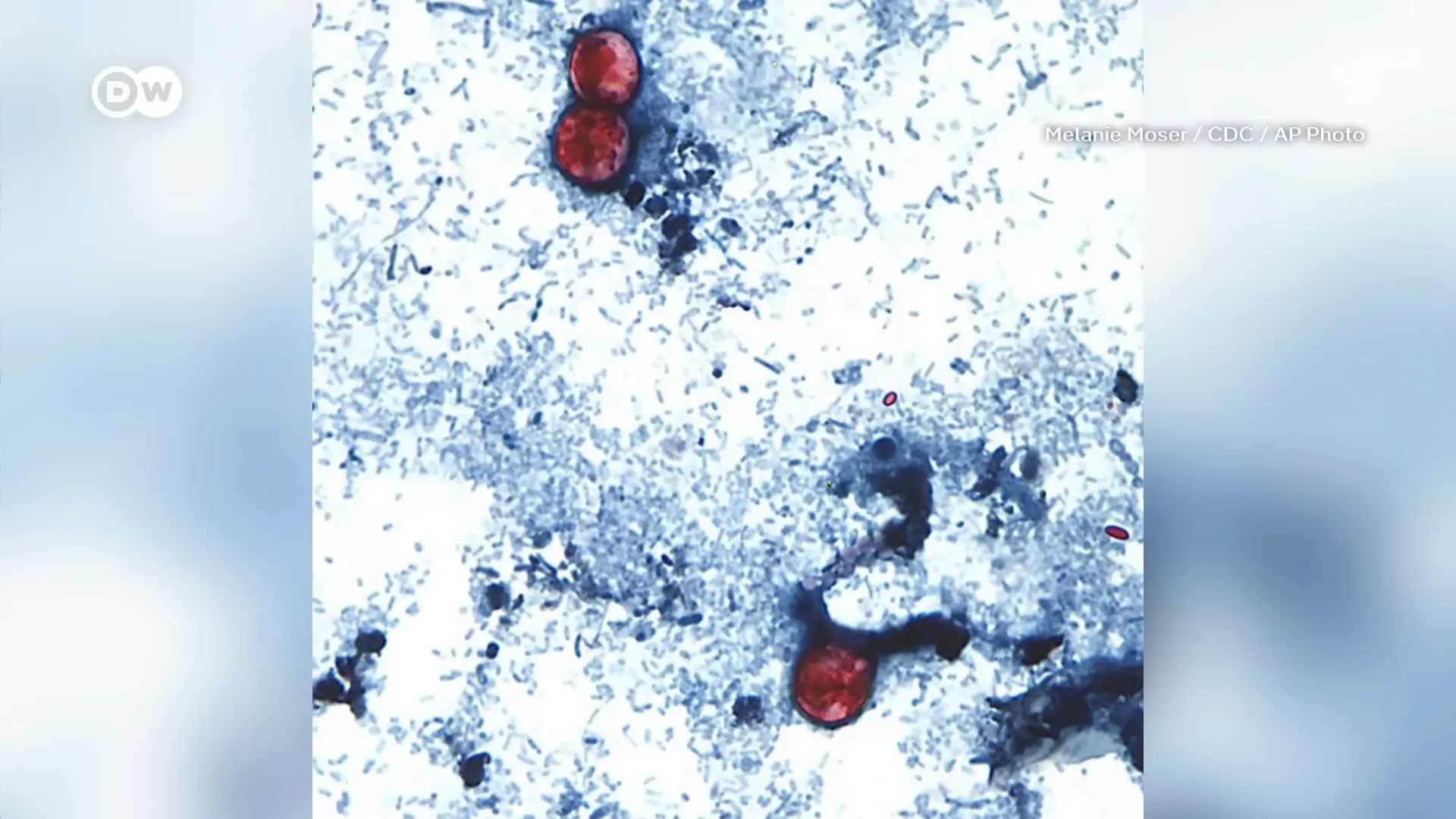


Video stills via DW News. Microscopy image credited on-screen to Melanie Moser/CDC/AP. Map via MapTiler and OpenStreetMap contributors.
The practical answer is not panic, produce avoidance or pretending a rinse makes every risk disappear. It is watching official updates, handling food normally and safely, and getting tested when prolonged watery diarrhea suggests this microscopic uninvited guest may have moved in.
Watch DW News Explain Why Cyclospora Is So Hard To Trace
Rutgers food-safety professor Donald Schaffner explains how Cyclospora reaches food or water, why multiple outbreaks may be unfolding and why washing produce cannot completely erase the risk.
Source: CDC, FDA and official DW News YouTube.