















A Moment of Zen: Watering the Water With What We Throw Away
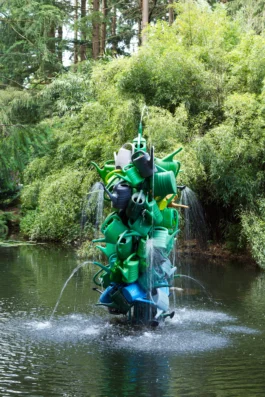
Sara Bjarland has a way of making discarded things feel oddly alive again. For PaltzBiënnale 2024 in Soest, the Finnish-Dutch artist turned a pile of unwanted garden watering cans into Watering the Water — a fountain sitting right where nature and the human-made start getting a little difficult to separate.
That tension is central to Bjarland’s work. She works with material traces left behind by humanity — broken, dirty, faded or otherwise unwanted objects that have slipped out of their original usefulness but haven’t quite stopped carrying meaning.
“I loved working on this private, landscaped estate, where nature and the human-made meet so clearly.”
Discover More
Sara Bjarland: Watering the Water
Discarded garden objects, a pond that does not need watering and one quietly absurd fountain sitting between nature and consumer culture.
Some links may be affiliate links. INYIM may earn from qualifying purchases.
A Fountain That Absolutely Does Not Need More Water
The result was two sculptural works for the landscape. Watering the Water was built from found garden watering cans and stands at roughly 300 × 120 × 120 centimeters. Gathered into a kind of unruly growth, the discarded cans become a working fountain — playful at first glance and just absurd enough to land the point.
Because, obviously, the pond does not need watering. The joke opens into something heavier: the mass-production of plastic objects, short consumer lifespans, waste, fossil-based materials and the larger environmental pressures surrounding water itself. One familiar garden object becomes a whole conversation about how easily we manufacture, use and toss things away.
The setting makes the work even sharper. PaltzBiënnale’s own writing on Bjarland points out that Landgoed De Paltz is itself a constructed landscape — a place where planted trees, designed grounds and even a mechanically controlled waterfall coexist with wildlife and the feeling of being deep in nature. Where does culture stop and “real” nature begin? Watering the Water seems perfectly happy to leave that question sitting there, spraying in every direction.
Bjarland’s wider practice follows the same instinct. She collects discarded materials and objects, then stacks, assembles, casts or otherwise nudges them into new forms with minimal intervention. The throwaway object does not disappear; it gets another life, and maybe a little dignity while it is at it.
And that is the Zen of it: something as ordinary as an old plastic watering can can become strange again if you give it enough space — and enough water.
See the fountain of art in action
The INYIM Media TikTok included with the original story is preserved below.

Don’t have TikTok? Watch on IG.
Source: Sara Bjarland; PaltzBiënnale.