




















The Glacier’s Red Secret Is a Pressure-Driven Brine Release
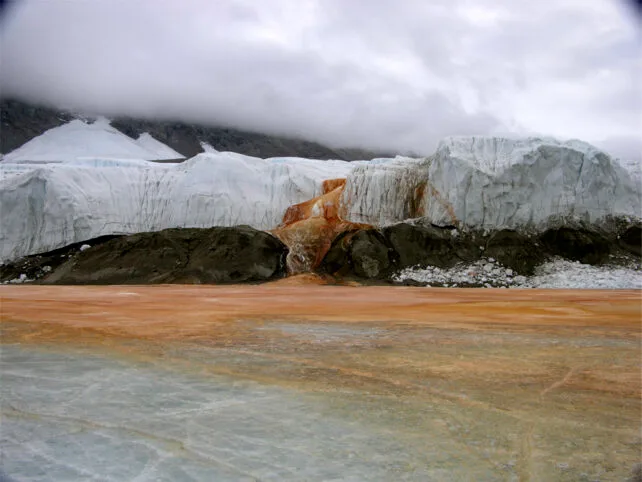
Antarctica is not bleeding, but Taylor Glacier does have one of nature’s most convincing horror-movie effects. The feature known as Blood Falls sends rust-red liquid across otherwise pale ice in the McMurdo Dry Valleys, making the glacier look as if somebody buried a practical-effects department beneath it.
Scientists have understood the broad reason for the color for years: an iron-rich, extremely salty brine reaches the oxygenated surface and turns red-orange as its iron oxidizes. The newer breakthrough is about the plumbing. A 2026 study caught a rare discharge event closely enough to show that the outflow coincided with a measurable drop and slowdown in the overlying glacier, plus a cold-water signal inside nearby West Lake Bonney.
Discover More
Explore Antarctica’s Strangest Living Laboratory
Read the 2026 Blood Falls study, then go deeper into hidden Antarctic brines, polar science and the search for life in extreme environments.
Some links may be affiliate links. INYIM may earn from qualifying purchases.
What Blood Falls Actually Is
Blood Falls appears at the snout of Taylor Glacier in the upper Taylor Valley of East Antarctica. The outflow moves toward the west lobe of Lake Bonney, one of the permanently ice-covered lakes that make the McMurdo Dry Valleys feel less like an earthly landscape and more like a rehearsal for another planet.
The liquid is not ordinary meltwater. It is hypersaline brine stored within and beneath the glacier, enriched with iron and other dissolved material. Its salt content lowers its freezing point, helping portions of the system remain liquid even while the surrounding ice sits far below the temperature at which fresh water would freeze solid.
The salts are believed to have a marine history. Long before the present glacier configuration, seawater and salt deposits were isolated as the landscape changed and Taylor Glacier advanced. Over immense stretches of time, that trapped water interacted with rock, sediments and microbial life while remaining cut off from sunlight and the open atmosphere.
The 2026 Study Caught the Glacier in the Act
The newest piece of the mystery comes from a short note published in Antarctic Science by Peter T. Doran and colleagues. The researchers did not create a new discharge on demand. Instead, multiple instruments happened to be watching different parts of the same system during a natural Blood Falls event in September and October 2018.
A time-lapse camera recorded the visible red outflow. A GPS station on Taylor Glacier measured a decrease in velocity along with an approximately 15-millimeter lowering of the glacier surface. Thermistors in West Lake Bonney detected cold-temperature anomalies consistent with subglacial brine entering the lake.
Those three signals lined up closely enough to provide a rare, coherent picture of a drainage event. As brine moved out from beneath the glacier, the overlying ice shifted downward and briefly slowed. The researchers describe Blood Falls as an iron-rich brine occasionally expelled from its subglacial source through the weight and movement of Taylor Glacier.
In plainer language: the glacier appears to squeeze and regulate the brine below it. When that buried fluid finds a pathway outward, the drainage is tied to a detectable response in the ice above and in the lake receiving the flow.
The study does not turn every remaining question into a neat little bow. Scientists are still working to understand exactly what initiates each irregular release and how the pathways evolve inside such cold ice. What the synchronized observations provide is unusually direct evidence that the visible “bleeding” is part of a connected subglacial hydrology system—not a surface stain appearing on its own.
Why the Water Turns Red
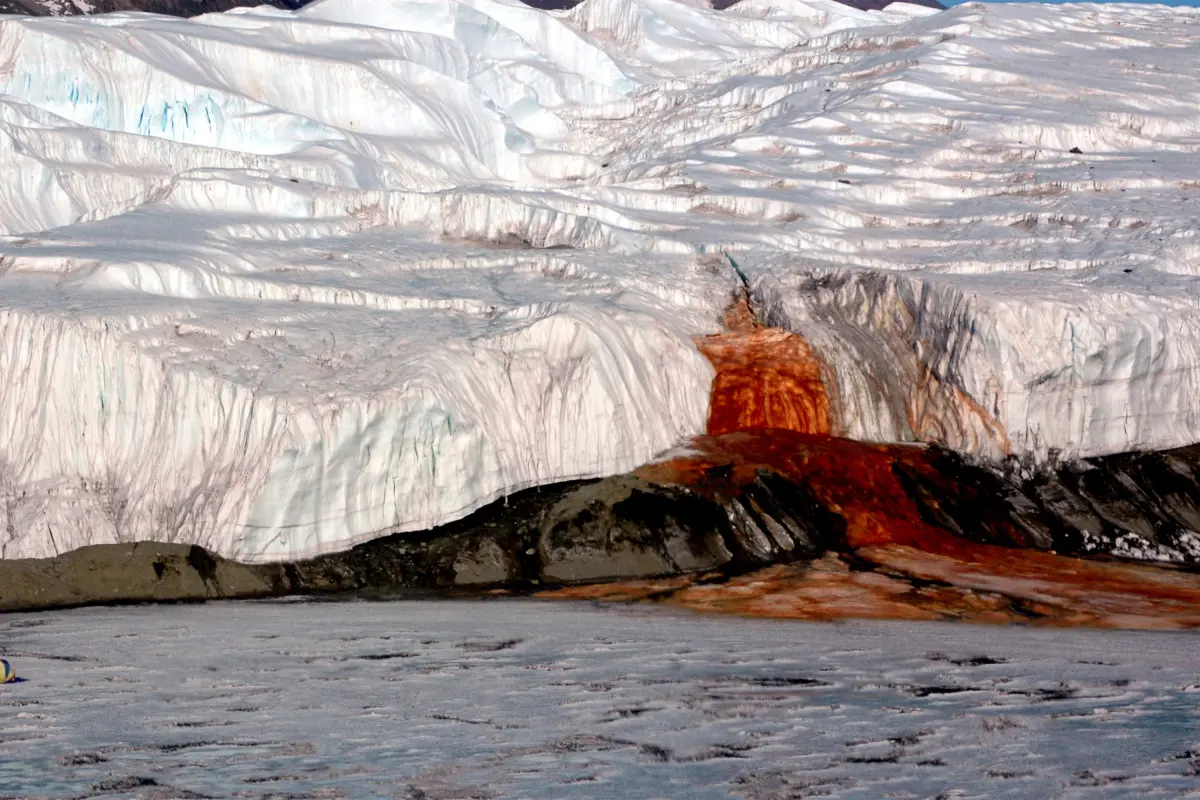
The famous color comes from iron chemistry, but the microscopic details are more interesting than the old one-word explanation of “rust.” When the oxygen-poor brine is still below the glacier, much of its iron remains dissolved or carried in tiny structures. Once the fluid reaches the surface and encounters oxygen, the iron changes chemically and produces the red, orange and brown staining visible across the ice.
A multi-technique mineral study found that Blood Falls samples contain abundant amorphous, iron-rich nanospheres mixed with elements including silicon, calcium, aluminum and sodium. Because these particles are extremely small and are not neatly crystalline, earlier testing methods could miss or oversimplify them.
That is the scientific plot twist: researchers were not wrong that iron oxidation creates the color, but the material doing the coloring is more complex than a straightforward pile of familiar crystalline iron oxide. Blood Falls is less “a glacier full of rust” and more a moving chemical system that changes the instant its hidden brine meets the outside world.
A Dark, Salty Ecosystem Survives Below the Ice
The brine matters for more than its dramatic entrance. Microorganisms have survived within this cold, dark and salty environment without sunlight, drawing energy from chemical reactions involving iron, sulfur, carbon and minerals in the surrounding sediments and bedrock.
These microbes grow slowly, but their existence shows that liquid water and biological activity can persist in places that look completely sealed off from the living surface. The system retains signs of its marine heritage while functioning as a modern subglacial habitat.
That makes Blood Falls a natural laboratory for astrobiology. The McMurdo Dry Valleys are routinely compared with Mars because of their extreme cold and dryness, while hidden brines beneath ice also raise questions about icy worlds such as Europa and Enceladus. Researchers studying Blood Falls are not claiming aliens are waiting beneath Taylor Glacier. They are learning what kinds of chemistry and life can endure when warmth, light and fresh water are all in very short supply.
The Name Is Gruesome, but the Science Is Better
Blood Falls was documented during the early twentieth century and was initially associated with red algae. Modern research replaced that idea with a far stranger reality: ancient salts, pressurized brine, nanoscale iron material, slow microbial metabolism and a glacier that physically responds when the buried system drains.
So yes, the ice looks wounded. In truth, it is showing off a hidden plumbing system that has been operating beyond ordinary human sight for ages. Antarctica brought the horror aesthetic; chemistry and glaciology supplied thee reveal.
Watch a Video Explainer on Antarctica’s Blood Falls
The supplied YouTube embed offers additional visual context for the red brine outflow at Taylor Glacier.
See Blood Falls Explained on Instagram
The reel below was shared by Detailed Explanation on Instagram.
Sources: Antarctic Science; U.S. National Science Foundation; NASA.