











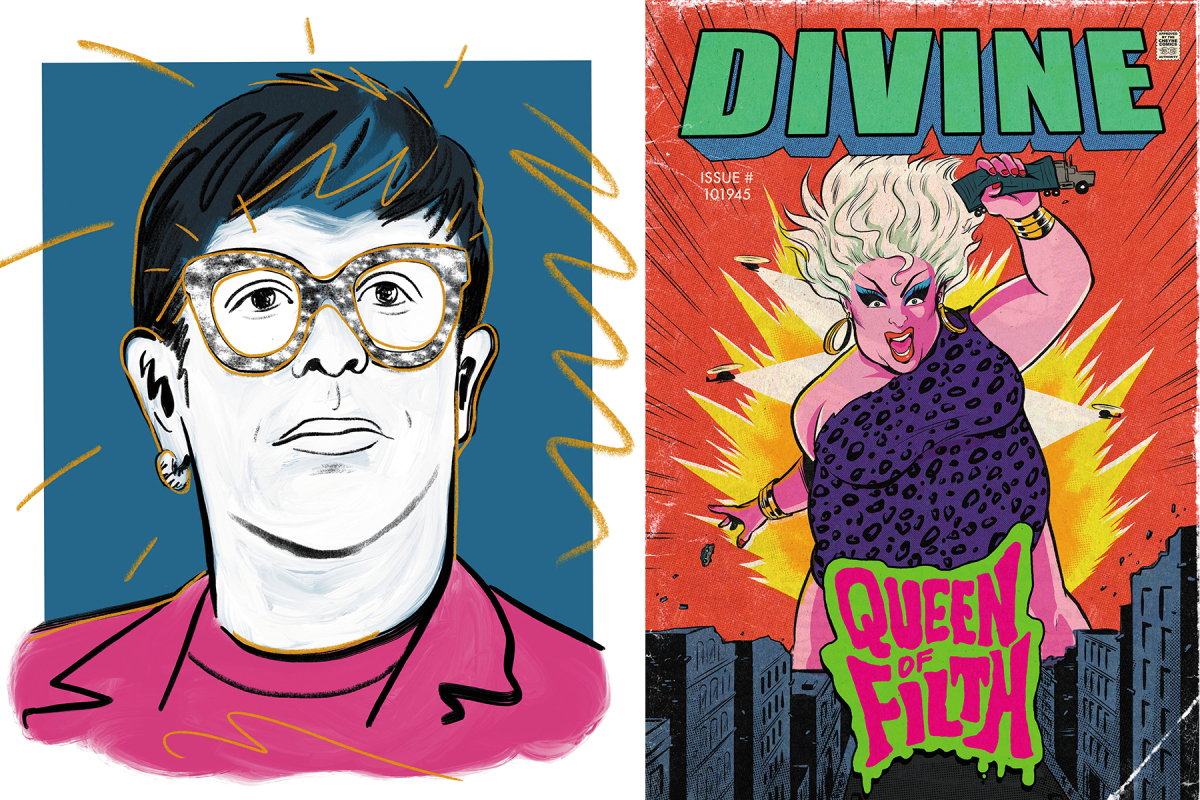
Elton John Via Comic Strip Illustraton Recounts Drag History & Remembers
‘True Punk Rebel’ Divine!
“In the upcoming book The Queer Bible, model, editor and queer activist Jack
Guinness compiles a collection of essays celebrating LGBTQ history and
culture through the eyes of some of art’s most prominent voices. In addition
to essays by Tan France, Gus Kenworthy, Paris Lees, Russell Tovey and Munroe
Bergdorf, Elton John discusses his life-long love for John Waters muse
Divine, the “Queen of Filth” who made indelible impressions in such films as
Pink Flamingos and Female Trouble.In this exclusive excerpt, Guinness discusses the book’s genesis and John
details how his love of Divine intersected with his own passion for drag.Jack Guinness on The Queer Bible
There’s a lovely tradition in the world of Drag, where ‘Mothers’ initiate
ingenue Drag Queens into the queer world, schooling the next generation in
LGBQTIA culture. I wanted to be able to create a resource that did this for
the entire queer community and their allies, and thus The Queer Bible was
born. The book is a compendium of LGBTQIA icons writing about someone who
helped them to become the person they are today: helping them embrace their
sexuality or gender identity, or inspiring their careers. The book features
contributors from many backgrounds including music, activism, sports,
literature, comedy, art and film.Elton John is my fairy Godmother – I’d met him and David a few times, but
never in my wildest dreams did I think they’d agree to be part of The Queer
Bible. It’s a testament to their generosity and passion for sharing queer
history with younger generations that they joined the list of incredible
contributors. Elton’s sheer joy and passion when talking about his chosen
icon, the drag legend Divine, is life-affirming.The AIDS epidemic cut down an entire generation in its prime, and stole the
lives of so many promising young men and women who would have gone on to
educate the next generation on queer culture. Elton and David’s tireless
work with the Elton John AIDS Foundation has raised millions, advocated for
change and saved countless lives around the world – through education,
prevention and treatment. It’s an honour to have them featured in the book.Editing the essays I understood that there can never be one type of queer
experience. No matter our sexual orientation or gender, our point of view is
singular, though our trials, tribulations and triumphs may be common. The
journey of self-discovery is universal. We all have to break away, from the
expectations of others and ourselves to live the most authentic versions of
ourselves.My journey, towards an authentic self – gosh I sound like a pound-shop Oprah
– has been tumultuous. I spent years as male model selling a certain type of
masculinity. I was told by numerous model agents to “butch” it up, whatever
that means. I policed my mannerisms trying not to appear too feminine,
adopting a “straight jacket” as Matthew Todd calls it in his fantastic book
of the same name. In my essay in The Queer Bible – devoted to RuPaul of
course – I describe this act as performing oppressive drag; the opposite of
everything real drag stands for. I wasn’t challenging, exploring or playing
with gender, I was hiding behind its most restrictive socially accepted
forms. I was complicit in my own imprisonment, trapped in a prison of toxic
masculinity.So many people, gay or straight, cis or transgender, feel stuck performing
gender roles. What a miserable existence. One day, I just had enough. It was
making me sick. I lost a dangerous amount of weight and my anxiety was
becoming unmanageable. Living a lie takes a terrible toll. When I eventually
came out in an interview, a few clients stopped booking me, but then Levis
cast me in their Pride campaign. They booked me for the very thing I’d been
told to hide. It was completely overwhelming. Things have changed so
quickly, there are so many out and proud models now with brilliantly
successful careers – it makes me so happy to see!In these politically unstable times, with LGBTQIA rights under threat the
world over, this book couldn’t be more necessary. This was never plainer to
me than when one of our contributors was violently assaulted in a homophobic
hate crime. Our trans contributors have to deal with horrific daily attacks
online and in the press. I see The Queer Bible as a platform to elevate,
celebrate and amplify the voices of our community. As a white cis man I
benefit from so much unearned privilege, and I’m so happy that this
collection shines a light on members of our community who so often aren’t
given the attention they deserve. I hope that the range of voices and the
varied stories, shared speak to the richness and diversity of our global
queer community.
These beautiful essays have taught me so much – Graham Norton’s will make
you laugh and cry, Tan France will inspire, Founder Of Black Pride Lady
Phyll will deeply move you, Munroe Bergdorf’s words will spur you to
activism, supermodel Hanne Gaby Odiele will educate, Mae Martin will
challenge you to question boundaries and live a freer life. Each piece and
accompanying illustration will open up new worlds. All our lives are richer
because of the works of queer individuals, and reading this book will shine
a light on the impact of these queer figures on shaping the world around us.
We stand on the shoulders of giants. It’s time to learn their names.Elton John on Divine
The very first time I saw Pink Flamingos, I fell for Divine. The film opens
on a shot of her mobile home, surrounded by kitsch garden ornaments.
Divine’s in hiding with her misfit family because the tabloids have
christened her the “Filthiest Person Alive.” Her look is instantly iconic:
hairline shaved right back, a shock of tangerine hair and pointed high
eyebrows. I felt an immediate connection. Firstly, because she was so funny.
Secondly, there aren’t many human beings like Divine, a quintessential, true
punk rebel.Divine was christened Harris Glenn Milstead but was better known as Glenn.
He grew up in Baltimore in the fifties, came of age in the sixties and made
friends with fellow upstart John Waters, with whom he developed his drag
persona, a larger-than-life Queen of Filth, Divine. Pink Flamingos was an
exercise in deliberate, exquisite poor taste. It purposefully revolted
audiences everywhere, dotted with cannibalism, bestiality and foot
fetishism. The world and I had never seen anything like it. It was banned in
numerous countries, so of course gained instant cult classic status. Divine
mutated into an international star, continuing to make films with Waters.My relationship with drag has been a life-long love affair. The first time I
ever saw anyone in drag was the early seventies. My manager, John Reid –
also the first person I ever slept with – took me to Danny La Rue’s club in
London. I was a very sheltered gay man back then and I didn’t know much
about this sort of thing. But schooled on the kind of campness sequestered
away on Radio 4, like Kenneth Williams, I was hungry for it all. I had no
idea real drag queens existed until that visit started the ball rolling.I quickly developed favourites. Lee Sutton at the Vauxhall Tavern; Regina
Fong at The Black Cap in Camden, who I would, incidentally, later get to
appear with at a Stonewall benefit. The glamour of drag connected with
something deep inside me. I can’t remember the first time I dressed in drag
privately, but it soon transpired into a public habit and to this day
comprises some of my happiest memories.If there was a chance to drag up, I would take it. I’d rented a house in St.
Tropez on holiday with my friend Tony King, who’s looked after me throughout
my career. The first time I met John Lennon – another of Tony’s designated
charges – was on a video shoot for the Mind Games album where Tony was in
full drag as the Queen. So, Tony and I decided to throw a drag party in St.
Tropez. The next day I took some of the other people out in drag and had
pictures taken privately by the swimming pool on the diving board.
Unbeknownst to us, there were paparazzi in the bushes and the photos ended
up plastered all over Paris Match the next week. Another time, in Hawaii, I
came down to dinner at the Four Seasons in full drag, looking like Audrey
Hepburn. I appeared on the front of Richard Avedon’s Versace book in a
sequined dress. I can make reasonable claims to being an actual cover girl,
darling. I have paid my drag dues.“Designating someone with a drag name was my way of telling them I loved
them.”When I came out as gay and met John Reid, he had so many gay friends and
employees it felt natural to give each other drag names. In a way,
designating someone with a drag name was my way of telling them I loved
them: drag is a communal sport – I like to get everyone involved. Tony
became ‘Joy’ and I became ‘Sharon’, because I was so common. Rod Stewart was
always ‘Phyllis’. Freddie Mercury became ‘Melina’ after Melina Mercouri, the
Greek actress and singer. He was a real Melina, I can assure you. John
Lennon became ‘Carol Dakota’ after his New York building, the Dakota. If you
can’t think of the correct name, you go to the surname first and work it out
from there. Not everyone gets a drag name. But all of my dearest friends are
bequeathed with one.It’s a rare joy when you love the art, get to meet the artist and love them
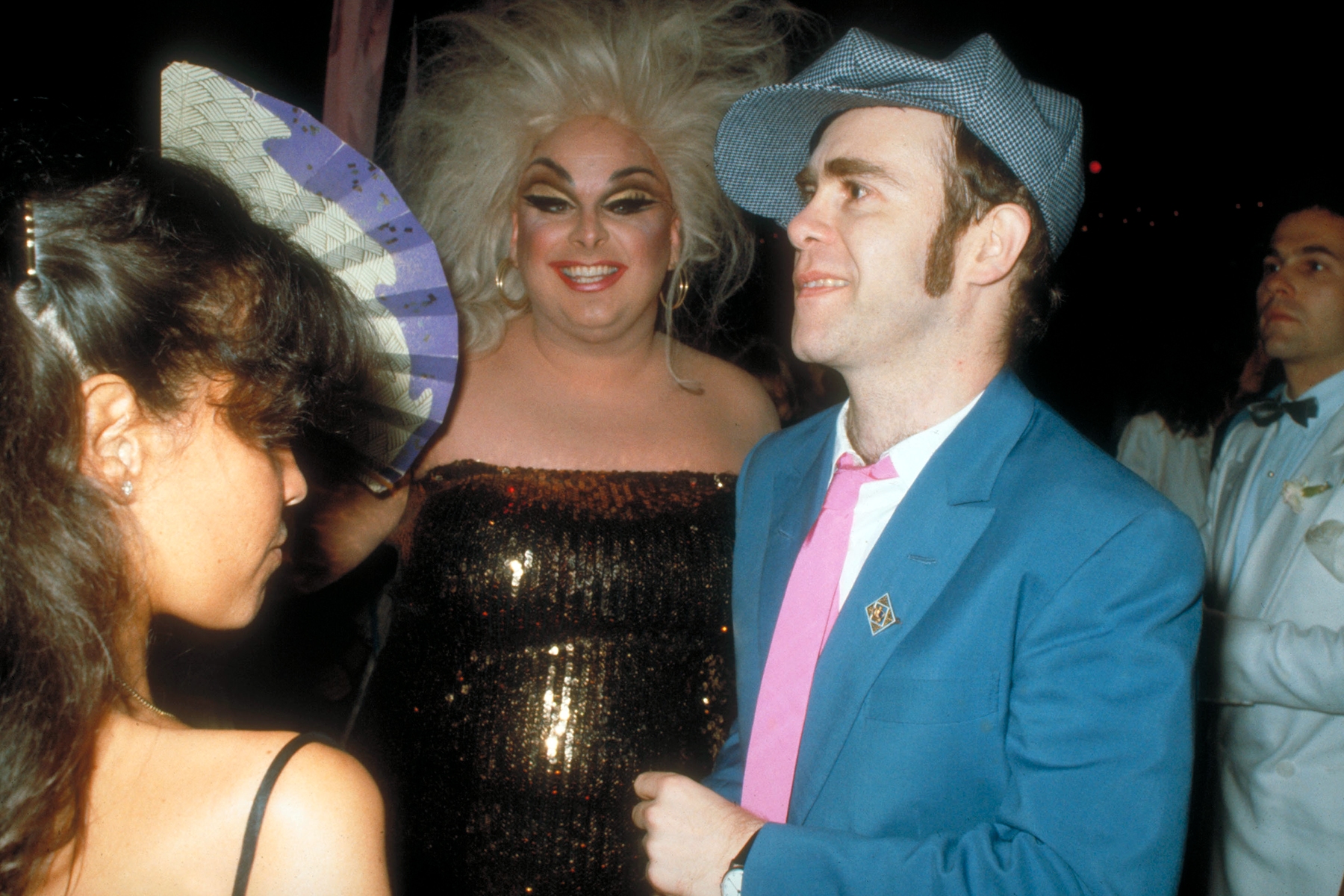
too. And that’s what happened when I met Divine – a friendship blossomed.
Nights out on the town with Freddie Mercury and Divvy followed a certain
rhythm. Divine would call, his raspy, lilting voice almost running his words
together, ‘Can I come over to smoke a joint?’ He would, then we’d go out to
dinner. Divvy was so lovely to be with. He was a very gentle character,
nothing like as flamboyant as his film persona. Then again, a lot of
performers aren’t. I’m not either. It was onstage and onscreen that he
expressed himself, his alter-ego screaming to get out. He just wanted to be
himself.That is exactly who I was when I started wearing the costumes and flamboyant
stage-wear that would become synonymous with “Elton John.” In my shows I’m
forever stuck behind a piano, so the outfits had to count. I looked to
people like Liberace, to anyone who had that essence of glamour within them
and weren’t scared to let it out. Drag artists perform gender in exaggerated
expressions which was exactly what I wanted to do. I lived my life so
playfully and excessively in my twenties and thirties because I had never
had the courage to live it in my teenage years. Like Divvy, I grew up in the
fifties, a conservative era. I knew nothing about sex and wasn’t allowed to
wear the clothes I wanted to. Glenn’s childhood had been similar in that
respect, and I could see that Divine’s spirit was very close to mine.“It’s a rare joy when you love the art, get to meet the artist and love them
too. And that’s what happened when I met Divine – a friendship blossomed.”For both of us, as soon as we could, we just burst onto the scene. Boy, did
we make up for lost time. In 1976, I invited Divvy onstage to perform
with me for an encore at Madison Square Garden. In hindsight, perhaps I
should have warned my band first. Still a cult star under Waters’ direction,
confined to the arthouse extremes, they had no idea who Divine was. I sat at
my piano and watched in awe as she climbed up the stairs to the stage in an
amazing foil dress. One of her heels snapped on the stairs, but of course
she styled it out, screaming, into her mic, “Oh fuck, my heel’s just
broken!” She rolled onstage and you could visibly read “Who the fuck is
this?” on the band’s faces. They had absolutely no idea. That night was just
me and Divvy having fun onstage in front of thousands of people.Divvy set something of a precedent at that show. On a later night of my
tour, I came onstage in drag as Tina Turner, in full “What’s Love Got To Do
With It” regalia. Skirt, wig, everything. I didn’t tell my band about that
either – just arrived onstage, sat down, and nobody knew who the fuck I was
until I started playing.The New York club scene in the seventies was incredible. It was all about
the music. Crisco Disco, Le Jardin and 12 West were fabulous, even though
one night, Crisco Disco refused Divvy and I entry. We’d gone out for a
lovely dinner and had both stolen ashtrays from the restaurant. We turned up
at Crisco Disco, Divine in a kaftan, me in some colourful, outrageous
outfit. The doorman shouted, “What do you think this is? Fucking Halloween?
You ain’t comin’ in here like this.” And Divine yelled, “Fuck you” exactly
in the manner of Dawn Davenport in Female Trouble and we both threw and
smashed our ashtrays and hotfooted it off to 12 West to dance the night
away.Divine and I certainly shared compulsive behaviours. I completely understand
where Divvy ended up. I was just as ravenous for my addictions as he was for
his. Luckily it didn’t kill me because I saw the light. For Divvy, eating
got so out of control that he became very unhealthy. I didn’t do drugs all
the time and was lucky in the sense that I worked, frequently on the road.
If drugs had kept me from touring, I’d be dead by now. There were periods
where I got and stayed clean, but I always went back to the drugs. I finally
got clean for good in 1990. It’s different for everyone. As much as I loved
Divvy, I can’t tell you what was going on inside him.Divine passed away from a heart attack in 1988. It was the night before
shooting was to begin on a role in the sitcom Married … With Children. Divvy
was about to finally fulfill his dream of performing as Glenn, as himself,
out of drag in a major role on television.“For me, Glenn’s death will always feel tied up with the height of the AIDS
epidemic.”For me, Glenn’s death will always feel tied up with the height of the AIDS
epidemic. It isn’t just the coincidence of the timing, at the height of the
pandemic. His life and career were cut short just as he was breaking into
the mainstream, on the eve of his acceptance as Glenn. That feeling of lives
being cut short, abbreviated at the precise moment they were blossoming, was
commonplace. It was simultaneously heartbreaking. In the eighties we lost an
entire generation of young gay men in their prime. It was a period of
intense loss, horrific both for me personally and for the gay community as a
whole. I was losing two or three people a week and it was all so
overwhelming. No one cared about what was happening. The press called AIDS
the “gay plague,” as if we had caused it. It was fucking frightening.Divine was the best of us. He was so brave, unique and fearless. He laughed
in the face of a conservative society which ridiculed and rejected him. But
Divvy internalised a lot of that trauma and pain and that certainly led to
his premature death. That’s why we need to protect the next generation of
LGBTQ+ people – especially those challenging gender norms – so that they can
go on to have long, happy, brilliant lives, living however they want to,
saying “fuck you” to all the hypocrisy, fear and shame built into so much of
mainstream society.“Divine was the best of us. He was so brave, unique and fearless. He laughed
in the face of a conservative society which ridiculed and rejected him.”I rewatched Female Trouble about a month ago with my husband David and was
utterly overwhelmed by how ahead of its time it was. Divine was a ray of
sunshine. And today I see so many drag queens performing, and non-binary and
transgender activists doing the most incredibly brave things. They are the
trailblazers, and we must applaud and support them. That’s what the Elton
John AIDS Foundation does.We want the people pushed out by society, the people John Waters loved and
championed, to know what they are worth. “No one gets left behind” is our
motto, and that’s what my life is all about. Whatever you’ve been through,
whatever you’ve done, everyone deserves redemption. Divine’s fearlessness
inspires me to this day. Divvy’s spirit will linger forever. Glenn was a
lesson to us all.” – Rollingstone.com